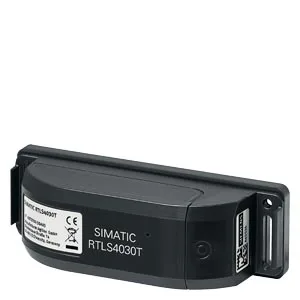
The Siemens 6GT2700-5DC05 is a SIMATIC RTLS4083T Plus transponder — a battery-powered UWB tag for the RTLS4000 real-time locating system. It uses phase-based UWB technology for sub-meter positioning in industrial environments like production lines, warehouses, and logistics yards where tracking assets or personnel is the requirement. The housing carries an IP65 rating, so it handles washdown, dust, and outdoor exposure — the tag can live on a forklift, a tool, or a worker's harness without a secondary enclosure. A 2.7-inch ePaper display with 296 × 128 pixels and a two-color LED gives the carrier on-the-spot information — job instructions, zone alerts, or asset ID — without needing to scan or dock the tag.
Range is listed at 30 m and 50 m for open-air applications (the manual governs actual performance). In a dense factory with racks and machinery, expect shorter reach; the UWB protocol (IEEE 802.15.4-2015 HRP) is designed for precision, not raw distance. Battery life depends heavily on update rate: standby lasts 1 year, a 1-second UWB localization cycle drops it to 6 months, and a 10-second display update cycle cuts it to 25 days. The Li-ion battery is not user-replaceable, so the tag's service life is the battery life — plan replacement cycles accordingly. Radio operates on 2.4–2.48 GHz and 3.1–7.0 GHz bands, country-dependent. The 3.1–7.0 GHz band is the UWB pulse, while 2.4 GHz handles the IEEE 802.15.4 backchannel. Verify local spectrum regulations before deploying across borders. Operating temperature for the display is 0 to 40 °C; the tag itself can survive storage from -10 to +50 °C. On the charging station, the acceptable range narrows to 10 to 40 °C. If the tag spends time in a hot warehouse before being issued, that storage spec is the relevant limit.
The tag measures 95 mm wide, 64.6 mm deep, and 13.8 mm tall — a slim, card-like profile. It fastens with cable ties or mounting clips, so it straps to equipment, vehicles, or lanyards without drilling or permanent fixtures. The housing is PC (polycarbonate) in Ti gray, and it is silicon-free — important for paint-shop or coating-line environments where silicone contamination causes surface defects.