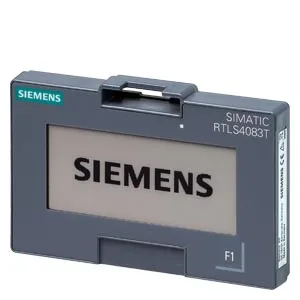
The Siemens 6GT2700-6DE33 is a SIMATIC RTLS4060T active UWB transponder — the tag half of a real-time locating system. It uses ultrawideband phase technology (RTLS4000) to report position, so the infrastructure knows where the tagged asset or person is inside a facility. It operates on two radio bands: 2405 to 2480 MHz (IEEE 802.15.4) and 3100 to 7000 MHz (IEEE 802.15.4-2015 UWB HRP PHY). The UWB band is what gives you sub-meter location accuracy; the 2.4 GHz band handles data exchange and configuration. Range depends on the environment. In open-air applications the UWB link reaches 30 m, and the 2.4 GHz link reaches 500 m. Always follow the manual for site-specific placement — walls, metal racks, and machinery will reduce those numbers.
Power and I/O — what the connector brings
Power comes through an 8-pin Bulgin connector (type PX0410/08S/6065). The supply range is 10 to 30 VDC, and the transponder draws a maximum of 3.5 W. That same connector also carries two digital inputs (24 V) and one digital output rated up to 250 mA — so the tag can read a limit switch or drive a small indicator without a separate I/O block. The housing is IP65-rated, light gray (RAL 7035), made from polycarbonate, and mounts with four M5 screws. Dimensions are 151 mm deep, 66 mm wide, and 43 mm tall — about the size of a small junction box.
This part carries an NRND (Not Recommended for New Designs) status from Siemens. That means it is still available for existing installations and BOM lines, but Siemens will not be introducing it into new projects. If you are building a new RTLS system, Siemens has a successor architecture to evaluate; for an existing RTLS4000 deployment, this tag remains the correct spare to quote against an RFQ. Configuration is stored on internal FLASH memory, and there is no backup battery in the product component — the tag is powered entirely from the 10-30 VDC supply.