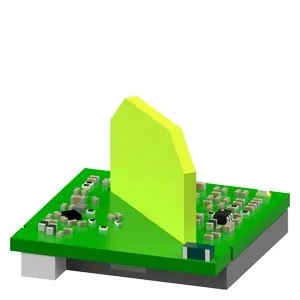
The 6GT2700-8DF00-0AX1 is a SIMATIC RTLS transponder in a special OEM PCB form factor, designed for the RTLS4000 real-time locating system using UWB phase technology. It's the tag that goes on assets or people, not the infrastructure anchor — the system anchors handle the position calculation.
Key specs that drive fit
The transponder operates on dual radio bands: UWB at 3100–7000 MHz per IEEE 802.15.4-2015 HRP PHY, and a secondary 2400–2480 MHz band per IEEE 802.15.4. Open-air range is specified up to 30 m and up to 50 m depending on conditions — but the typical read range is 3 m, so don't spec it expecting 50 m in a warehouse with racking. That 50 m figure is best-case open-air only, and the manual must be followed for reliable operation. Power comes from a 3.3 V supply (within ±100 mV) at max 0.5 A, delivered through a JST SM02B-SRSS-TB connector intended for connection to a screwdriver battery. This is not a line-powered device — it's meant to be mobile, battery-fed, and swapped out when the battery runs flat. No backup battery is onboard, so configuration memory (FLASH type) retains settings without power. Physical dimensions are compact at 25 mm depth, 25 mm width, and 18 mm height, but mounting is customer-specific — there's no DIN rail clip or standard bracket. You'll need to design your own mounting solution for the OEM PCB. IP00 means zero ingress protection; this is strictly indoor, clean-environment gear. Operating temperature range is 0 to 50 °C during read/write access and outside the read/write area, with the same range for storage. No derating curve is provided, but the narrow window means this isn't for freezer or hot-roof applications. A single LED serves as the display — expect basic heartbeat or status indication, not a rich diagnostic interface.
The transponder is a mobile tag in the RTLS4000 ecosystem. It communicates with fixed UWB anchors that compute position. The 3.3 V battery supply and compact PCB mean it's designed for integration into a custom enclosure — think asset tags, tool tracking dongles, or personnel badges. There's no fieldbus, no IO-Link, no Modbus — just the radio link back to the RTLS infrastructure.