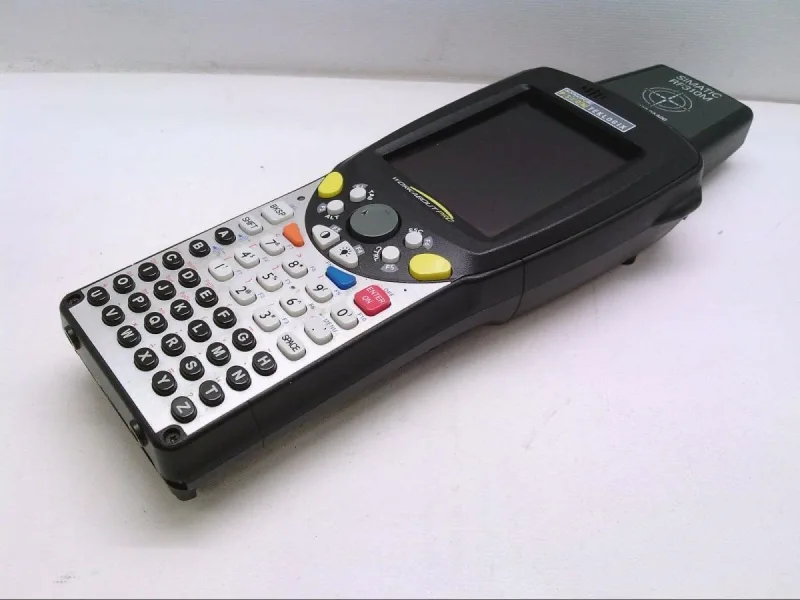
The Siemens 6GT2803-0AC10 is a SIMATIC RF310M mobile RFID reader — a handheld unit built for reading and writing RF300 and ISO 15693 transponders, including the small ones that fixed-mount readers struggle with. It operates at 13.56 MHz and supports RF300-specific, ISO 15693, and ISO 18000-3 protocols, with a maximum transfer rate of 106 kbit/s. The read range hits 80 mm, but that figure depends on the external antenna you pair it with — ANT 8, 12, 18, or 30 are the supported options. The 3.6-inch VGA color touchscreen (480 × 640 pixels) and alphanumeric keypad give the operator a full interface for on-the-spot tag interrogation without needing a separate terminal.
Built for the pit — IP54 and a lithium-ion spine
IP54 protection class means it shrugs off dust and splashing water — fine for a mill floor or a warehouse, but not for a washdown zone. For a handheld that moves between a crusher station and the control room, that's the right balance. It runs on a 3 Ah lithium-ion accumulator with fast-charging capability, giving a typical operating period of 8 hours per charge. The battery is permanently installed and not customer-replaceable — plan for the unit to go back to service when the pack eventually degrades. Operating temperature spans -20 to +50 °C, and storage range is -40 to +60 °C, so it handles the thermal swings of a parked vehicle or unheated storage shed. It's rated for a 1.5 m drop — a realistic spec for a handheld on a plant floor.
Lifecycle reality — mature product, sourced to order
We can source it, but it's not a shelf-stocked commodity — expect lead time discussion when you send the inquiry. The listed MTBF of 55 years is a reliability engineering figure, not a warranty. It tells you the mean time between failures for a population of these units under controlled conditions — useful for spares planning in a multi-reader deployment.
Software and connectivity — what the operator sees and how you program it
The unit ships with Windows Embedded CE 5.0 and the RF310M.exe application pre-installed for executing RF300 and ISO 15693 transponder operations. Programming is done via.NET and C++ using Microsoft Visual Studio through the 'RFID reader interface' API — standard tooling for an embedded Windows device. Connectivity includes a tether port with RS232 and USB 1.1, plus a docking connection with low insertion force (LIF) for the charging/docking station. It's not a multitag-capable reader — one tag at a time. Onboard memory: 256 Mibyte RAM, 1000 Mibyte data and program memory, with 900 Mibyte of usable data memory.