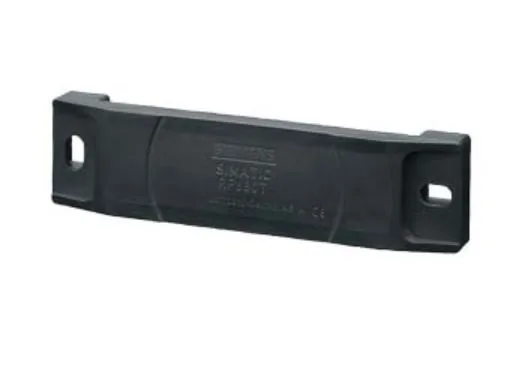
The Siemens 6GT2810-2AE83-0AX3 is a SIMATIC RF630L SmartLabel — a passive UHF RFID tag on a white PET substrate, sized 75 x 25 mm. It operates across the full global UHF band (860 to 960 MHz) and uses the NXP Ucode 8 chip with 128-bit (16-byte) EPC memory and no user memory. The tag communicates via EPCglobal Class 1 Gen 2 / ISO 18000-63 at up to 320 kbit/s, and supports multitag reading. This means it's compatible with any standard UHF RFID reader that speaks those protocols — no proprietary lock-in. The label is designed for the SIMATIC RF600 system, specifically for use with the RF630L reader. Its linear polarization and strong one-side adhesive suit it for direct attachment to assets or products in industrial environments. The PET material handles torsion and bending conditionally — treat it as a surface-mount label, not a wrap-around tag.
The 130 °C peak covers brief exposure during paint curing, autoclave cycles, or hot washing — but the chip won't be readable at that temperature. Storage is tighter: 5 to 25 °C, with a maximum shelf life of 2 years. If your application involves sustained heat above 85 °C during reading, this tag isn't the fit. IP67 in bonded state, and described as suitable for washing facilities and carwash-proof. That means the label survives high-pressure spray and immersion when properly adhered to a clean, dry surface. The adhesive is described as strongly adhesive and custom-made for the application — but the IP67 rating only holds while the bond is intact. If the substrate is oily or curved, pre-qualify adhesion before committing the BOM line.
Memory and data structure — what the 128-bit EPC means for your application
The NXP Ucode 8 provides 128 bits (16 bytes) of EPC memory, lockable, unlockable, killable, and password-protectable. There is no user memory — the 16 bytes are the entire writable payload. That's enough for a unique serial number or a part ID, but not for storing process data, a maintenance log, or a full GTIN. If your application requires user memory (e.g., writing a last-test-date or cycle count onto the tag), this chip won't support it. The memory organization is EPC-only.