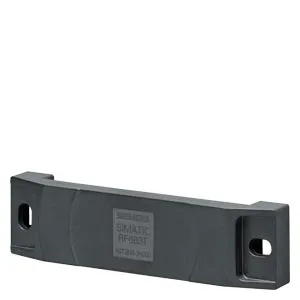
The Siemens 6GT2810-2HC81 is a SIMATIC RF620T container tag — a rugged, IP67-rated UHF RFID transponder built for the RF600 reader system. It operates across 860 to 960 MHz (covering global UHF bands) and complies with EPCglobal Class 1 Gen 2 and ISO 18000-63 protocols, so it talks to any standard UHF reader that speaks those protocols. The tag carries an IMPINJ MONZA 4QT chip with 128-bit EPC memory (expandable to 128 bit) and 64 bytes of user memory, plus a 32-bit TID. That user memory is useful for storing lot numbers, maintenance history, or a second identifier alongside the EPC. Read range is listed at up to 8 m, but that's reader-dependent — the system manual (RF600) is the authority for actual performance in your layout. Overrange is possible, so don't treat 8 m as a hard ceiling.
Dimensions are 127 mm deep × 38 mm wide × 6 mm tall — a slim, rectangular form factor that mounts via gluing, two M5 screws, or the optional spacer kit. The polypropylene (PP) body in anthracite is laser-engravable for your own asset numbering. IP67 means the tag survives washdown, dust, and temporary immersion — suitable for container tracking, pallet ID, or outdoor asset tagging where moisture and dirt are the norm. Shock resistance meets DIN EN 60721-3-7 Class 7M3 at 1000 m/s², and vibration resistance is 500 m/s², so it holds up on forklift-mounted containers or conveyor pallets.
Environmental limits and memory handling
Read/write temperature range is -25 to +85 °C; outside read/write access it survives -40 to +85 °C. Storage range is -40 to +80 °C. That covers most industrial and outdoor environments short of foundry or cryo. Memory is EEPROM with lock, unlock, write protection, and password protection features. No backup battery — it's passive, powered by the reader field. Multitag-capable, so you can read multiple tags in the field simultaneously.
cULus approval is listed, so it's accepted for installations requiring UL recognition in the US and Canada. No IECEx rating — not certified for explosive atmospheres.