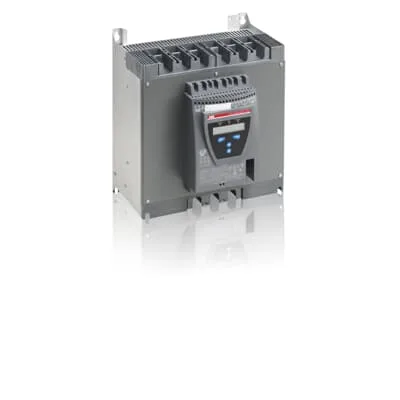
What this PST210 softstarter does on your motor circuit
The ABB PST210 1SFA895012R7000 is a softstarter for three-phase induction motors, rated 210 A in-line connection and 110 kW at 400 V. That 210 A figure is the continuous current the main terminals carry in a standard line configuration — sized for a motor drawing that full-load current, not a service-entrance rating. The inside-delta connection bumps it to 360 A and 184 kW at 400 V, which is the more common wiring for larger motors because it shifts the softstarter's thyristors out of the main power path once the bypass relay closes. Main circuit voltage range is 400 to 690 V AC, so it covers 400 V and 690 V industrial networks without a separate voltage tap. Control supply is 100-250 V AC — make sure your control transformer is sized for that range, not a fixed 120 V tap. The current limit function is adjustable from 1.5 to 7 times the motor rated current (Ie), and the ramp time spans 0 to 120 seconds. That ramp is the time the softstarter takes to bring the motor from standstill to full speed — set it long enough to avoid a hard start on a conveyor or pump, but short enough that the motor doesn't sit in current-limit too long.
Main circuit terminals are bars with a 10.2 mm hole — expect to land lugged cable, not bare wire. Control circuit terminals accept 1 x 2.5 mm² rigid and need 0.5 N·m of torque. The supply circuit (the control power feed) also takes 1 x 2.5 mm² rigid. Degree of protection on the main terminals is IP00 per IEC 60529 and IEC 60947-1, so this lives inside a panel — no washdown exposure on the power lugs. Communication is via a FieldBusPlug (standard), meaning it accepts the ABB fieldbus adapter module that plugs into the front. No onboard Ethernet or PROFIBUS — the plug is the interface point. Analog output is 0-10 V, useful for feeding a speed reference or a panel meter showing motor current. Four signal relays are built in: run, fault, bypass, and overload. That covers the typical status feedbacks a PLC needs — run permissive, fault reset, bypass confirmation that the contactor has closed, and a dedicated overload trip signal. LEDs on the front show fault (red) and protection (yellow) status.