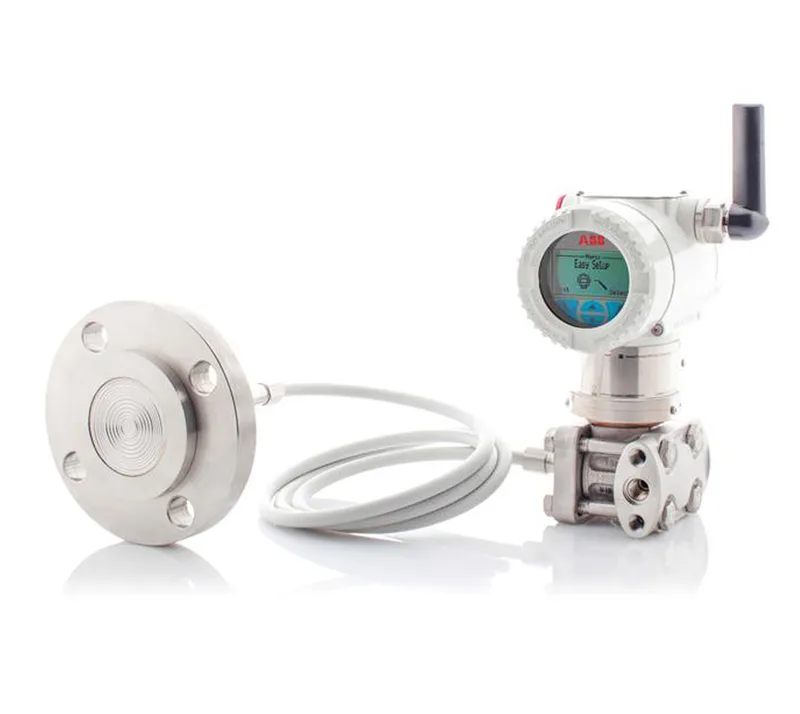
Instrumentation field note: what this build code delivers
The 266HRHHRRB1E1L1B7H1+S26RAHE1SFHM2AHSNNN is a gauge pressure transmitter with a remote seal assembly — the S26RA rotating flange diaphragm seals (flush and extended). The transmitter side connects to the high-pressure port. Span limits are set at H: 2.67 to 160 kPa (26.7 to 1600 mbar, 10.7 to 642 inH2O). Output is 4-20 mA with HART digital communication, which supports the audit trail for loop configuration changes in a qualified system. The diaphragm material is Hastelloy C-276, specified for corrosive process media where AISI 316L would not hold. Fill fluid is silicone oil DC200 10 cSt. Capillary length is 4.5 m (15 ft) with AISI 316L SS armour protecting the capillary run. Hazardous area certification is ATEX Intrinsic Safety: II 1 G and II 1/2 G Ex ia IIC T6; II 1 D Ex iaD 20 T 95 °C and II 1/2D Ex iaD 21 T95 °C. This covers Gas Group IIC (hydrogen, acetylene) and dust zones 20/21 — qualifiable for a sterile-fill suite where the transmitter lives in a classified area.
Material traceability is specified at H1: Certificate of compliance with the order EN 10204–2.1 for process wetted parts. This satisfies the documentation requirement for a pharmaceutical GMP line where every wetted component must be traceable under change control. The ATEX certificate covers the full transmitter and seal assembly as a single certified entity.
Mounting and process connection
Mounting flange material is AISI 316 SS, rating ASME CL150 / 2 in. The mounting bracket (B7) is AISI 316L SS for pipe or wall mounting. Housing is aluminium alloy barrel version with M20 x 1.5 electrical connection. The integral LCD (L1) gives local pressure indication — useful during commissioning to verify the 4-20 mA loop matches the displayed value before locking the configuration. No flushing ring is fitted (N = None). The seal surface finish is smooth (2). The remote seal assembly includes the S26RA rotating flange, which allows alignment of the bolt holes after the diaphragm is positioned — helpful when the vessel nozzle orientation is not perfectly indexed to the pipework.