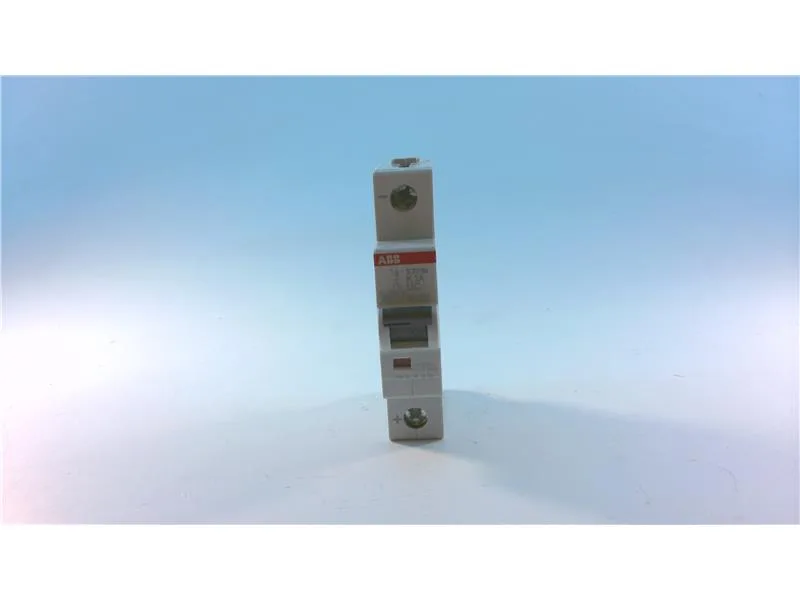
The K curve trips magnetically at 8–12× In, which means it tolerates the brief inrush of small transformers, solenoids, or motor starters without nuisance opening — while still protecting the 1 A circuit against hard faults. At 277 V AC (line-to-neutral in North American 480Y/277 V panels) it interrupts up to 6 kA; on the DC side, the same unit clears faults at 250 V DC with a 10 kA interrupting rating, making it usable in DC sub-distribution or PV combiner boxes where DC arc extinction is more demanding.
The single-pole width (roughly 17.5 mm) leaves room for adjacent breakers in a multi-pole assembly. Spring-cage terminals accept 0.2–2.5 mm² solid or ferruled stranded conductors; strip length 8 mm avoids whiskers under the cage.
How it differs from a Curve C sibling
The closest peer in the same S200MUC family is the S201M-C3 (3 A, Curve C). Both share the 1-pole DIN-rail footprint, 277 V AC / 6 kA interrupting rating, and 10 kA DC rating. The deciding difference is the trip curve: Curve C trips at 5–10× In, while Curve K trips at 8–12× In. For a 1 A circuit feeding a control transformer or a contactor coil, the K curve's higher magnetic threshold avoids nuisance trips on the inrush — the C curve at 3 A would be a different amp rating and a tighter tolerance on inrush. If the panel was originally specified with S201M-C3, swapping to the K-curve variant requires checking that the load's inrush profile and the required interrupting capacity still align.