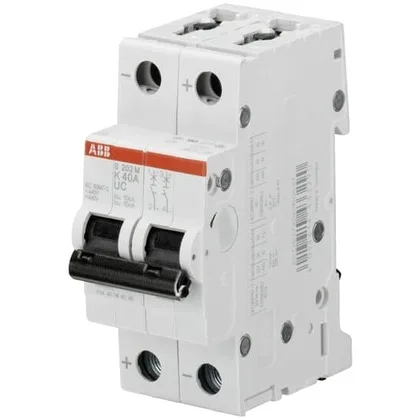
On a 10 A breaker, the magnetic trip engages between roughly 20 A and 30 A, clearing a fault before the silicon junctions can melt. The 6 kA interrupting rating at 277 VAC handles the fault current available at a typical panelboard secondary; the 10 kA DC rating at 500 VDC covers battery-backed DC bus circuits common in UPS and solar combiner boxes. The 277 VAC rating covers line-to-neutral on a 480Y/277 V wye system; the 500 VDC rating is unusual for a 2-pole breaker this compact, making it a candidate for string-level DC protection where array voltage stays under 500 V.
Deployment context
In a panel environment, this breaker occupies two DIN-rail modules (36 mm width). The Z-curve trip makes it a poor fit for general-purpose motor branch circuits — those want a C or D curve to handle inrush — but it is the right choice for protecting power supplies, drives input rectifiers, and DC link capacitors where the load is nearly resistive or has a low surge factor. Wire it with the same torque and strip length as any S200 series terminal (2 N·m, 8 mm strip).