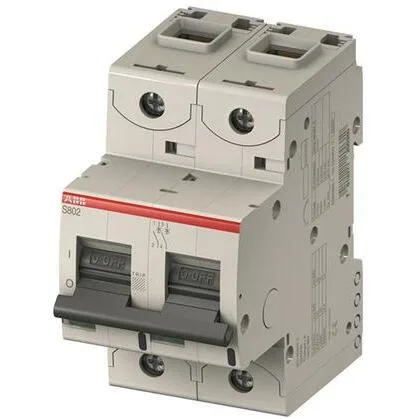
Integrator note — 63 A Curve C on a 2-pole DIN footprint
The 63 A rating makes this a feeder or subfeed breaker in a panel, not a final branch device for small loads.
The 2-pole form factor occupies two module widths (typically 36 mm total), so it fits alongside other DIN-rail components in a structured panel layout. At 63 A, the line-side and load-side conductors need to be sized for that continuous current; the breaker's terminals accept the cable cross-section that 63 A demands (typically 16–25 mm² copper).
Coordination note — Curve C vs. Curve B or D
The Trip Curve C characteristic (magnetic trip at 5–10× In) sits between Curve B (3–5× In, used for resistive loads or long cable runs) and Curve D (10–20× In, for high-inrush loads like large motors or welding equipment). For a 63 A circuit feeding a distribution subpanel with mixed loads — some motor starters, some lighting — Curve C is the typical choice: it tolerates the starting surge of small motors but still trips fast on a bolted fault. If the downstream load is purely resistive (heaters, lighting), Curve B would offer tighter protection; if it's a single large motor, Curve D might be specified instead.