What this sensor does in a zoned conveyor line
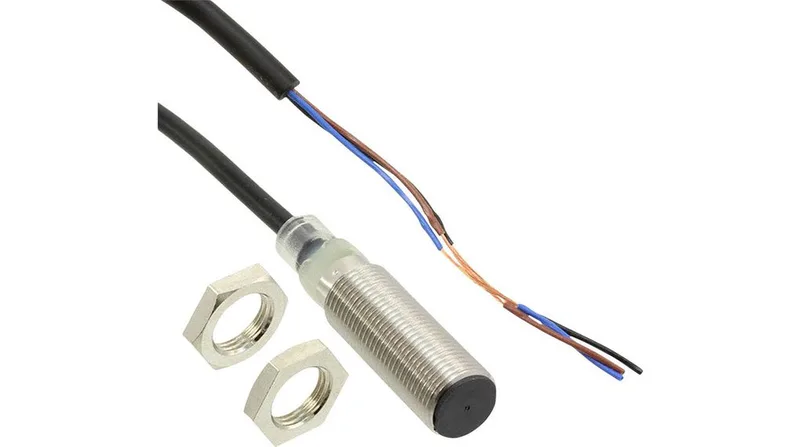
The Omron E2BM12KS04WPB22MOMI is an M12 flush-mount inductive proximity sensor from the E2B series, delivering a 4 mm sensing distance at 1 kHz switching frequency. Its PNP break contact (NC) output means the signal drops when metal is present — useful for detecting a pallet's absence in an accumulation zone or confirming a divert gate has cleared. The IP67 brass housing and 2 m cable let it mount directly on a conveyor side-rail or transfer plate without a separate junction box.
The 4 mm flush-mount sensing range is the maximum detectable distance to a standard steel target when the sensor face is flush with the mounting surface. On a conveyor, that catches a metal flag or bracket passing within that gap — anything farther and the sensor stays off. The 1 kHz switching means it can detect targets moving past at line speeds up to roughly 60 m/min (assuming a 10 mm target), which covers most parcel and pallet handling. The PNP NC output is normally closed: the signal is high until metal enters the sensing field, then it goes low. That's the opposite of a make-contact (NO) sensor, so verify your PLC input logic before wiring. Operating voltage range is 10–30 VDC, drawing 10 mA quiescent and switching up to 200 mA load. The 10 % repeat accuracy means the sensing point can shift up to 0.4 mm from cycle to cycle — fine for presence detection, not for precision positioning. IP67 handles washdown and dust, but not high-pressure spray (that would need IP69K).
The closest functional peer is the E2BS08KS02MCB120OMS — an M8 flush-mount sensor with 2 mm range, PNP NO output, and an M8 connector instead of a 2 m cable. The M12 form factor here (17 mm body width vs 13 mm) and the NC output are the main differences. If your panel was wired for the M8 connector, this sensor's 2 m cable means you either terminate in a junction box or swap to a connector variant. The sensing distance is double (4 mm vs 2 mm), so it can detect a larger target or mount farther from the metal.