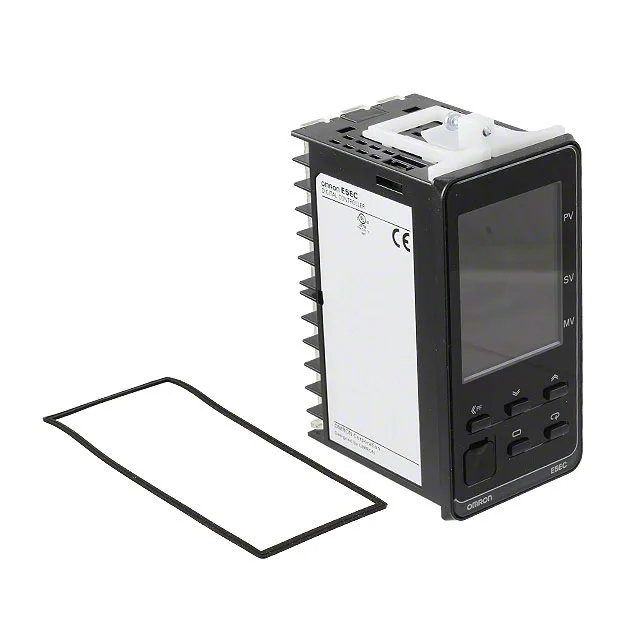
Six relay outputs for multi-zone or staged control
The E5EC-RR4D5M-010 carries six relay outputs — that is more than the usual four found on most E5EC variants, giving you independent control loops for multi-zone ovens, staged heater banks, or combined heat/cool applications without adding external relay packs. Each relay switches the process load directly; the 24VAC/DC supply rail means it drops into panels already running 24V control transformers without a separate power module.
Sensor compatibility and input range
Accepts RTD, thermocouple types B, E, J, K, L, N, PLII, R, S, T, U, W, plus 0–20 mA and 0–10 VDC analog signals — covering the full range from -200°C up to 2300°C depending on sensor type. The universal input means one SKU handles both temperature and process signals; a field swap from a thermocouple to a 4-20 mA pressure transmitter requires only a configuration change, not a different controller model.
Heater fault detection and event input
Built-in heater fault detection monitors the load current via an external CT and flags a broken heater element or SSR short — a common failure mode in electric furnaces and injection molding barrel heaters that otherwise runs unnoticed until the process drifts. The event input accepts a dry-contact or NPN signal for remote start/hold, alarm reset, or setpoint switching, reducing the need for a separate PLC digital input module on simple machines.
Panel fit and IP66 front
Panel cutout is 92.00 mm x 45.00 mm — the standard 1/4 DIN horizontal footprint — and the screw terminals accept up to 14 AWG for the power and output wiring. IP66 rating on the front panel means it withstands hose-down cleaning in food processing or washdown environments; the gasket seals against the panel cutout edge, not just the bezel.
The closest functional sibling is the E5EC-QR4D5M-010, which swaps two of the six relay outputs for voltage (SSR drive) outputs — same panel cutout, same input range, same supply voltage. If your application drives external SSRs rather than switching loads directly, that variant saves the cost of unused relay contacts.