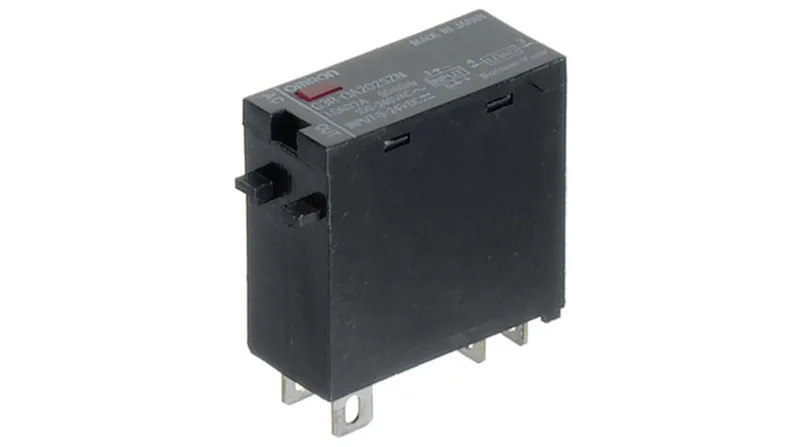
Where this G3R sits in a control panel
The Omron G3ROA202SZNUTU524DC is the G3R-series solid state relay designed for low-current AC load switching where a mechanical relay's contact bounce or arc would shorten service life — heaters, solenoid valves, indicator lamps, and small process loads that need silent, bounce-free cycling. With a 2 A load rating and a 264 V maximum load voltage, it is sized for the low-power end of the panel: not for motor starters or heater banks pulling tens of amps, but for the dozens of discrete outputs that sit downstream of a PLC or temperature controller. Zero-cross switching means the output device turns on at the AC mains voltage zero-crossing point rather than at an arbitrary phase angle — the practical effect is that the inrush and EMI associated with switching a transformer or capacitive load mid-sine are suppressed, so the relay is gentler on the downstream load than a random-phase SSR.
Load and control windows, 50 mA to 2 A and 75 V to 264 V
The output stage accepts a load current from 50 mA minimum up to 2 A maximum across a load voltage range of 75 V to 264 V, which lines up with the nominal 100–240 VAC mains band found on most global machine control panels. The 50 mA minimum is the floor below which the SSR's snubber network cannot reliably commutate off-state leakage — anything below that needs a dummy load resistor in parallel. On the control side, the input accepts 4 V to 32 V DC, which covers the 5 V logic level, the 12 V and 24 V field busses common to PLC discrete outputs, and the upper end of low-voltage DC supplies without an interposing relay. The push-in termination accepts ferruled or solid conductors directly — no tooling on the screwdriver slot is needed for solid wire, which speeds panel build but means stranded wire without ferrules needs a check.
13 mm wide, socket-mounted in the G3R footprint
The body is 13 mm wide by 28 mm tall by 29 mm long, which is the slim G3R-series socket-mount footprint — these plug into a standard G3R-series socket that handles the screw or push-in field wiring, so the SSR itself can be swapped out for service without disturbing the panel wiring. Frequency coverage is listed at 50 Hz minimum to 60 Hz maximum, matching the two mains frequencies encountered in global machine design without further configuration. Sockets for the G3R series are sold separately, and the wiring channel should be planned so the socket sits where the technician can reach it — a 2 A SSR in a 30-device panel is rarely the failure candidate, but the day it fails is the day access matters.
The G3ROA202SZNUTU524DC sits in the mature lifecycle stage per the manufacturer's record — meaning it remains a catalog part, but the G3R platform is no longer a focus of new design activity. For an existing line running this part, that is a normal supply state: the BOM keeps building, replacements stay available, and the panel documentation does not need a re-issue. For a brand-new design, a more recent platform is the better starting point.