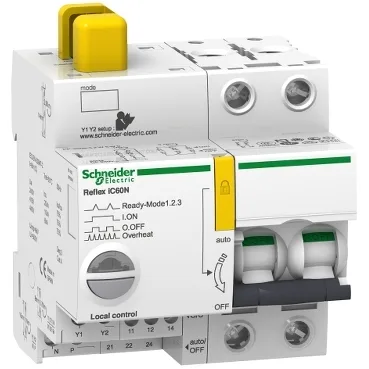
The 2-pole version breaks both line and neutral, which matters when the neutral is not bonded to earth downstream. The IP20 finger-safe terminals are fine for enclosed panels; if the breaker lives near a washdown zone, it needs a separate enclosure.
Rated 20 kA Icu at 220…240 V AC and 10 kA Icu at 380…415 V AC, both per EN/IEC 60947-2 — that is the maximum fault current the breaker can safely interrupt without welding contacts or rupturing the case. The 'N' in iC60N designates the N breaking capacity class, which is the standard industrial grade for this platform.
Control flexibility and integration into a circuit
The control circuit accepts multiple signal types: impulse (momentary pushbutton), maintained (latching contact), or maintained very low voltage (24 V DC or 24 V AC). The control voltage options cover 230 V AC, 24 V AC, 48 V AC, 24 V DC, and 48 V DC — so it works with both line-voltage pilot devices and low-voltage PLC or relay outputs. The toggle and ON/OFF button on the front give local manual override, and the padlock provision (OFF position only) lets a lockout/tagout program secure the circuit during maintenance.
Environmental and durability ratings
Tropicalisation class 2 means the breaker is treated against moisture and fungal growth for use in warm, humid climates. Electrical durability is 50,000 cycles at AC-1 (resistive load), mechanical durability the same 50,000 cycles — that is a solid service life for a control breaker that cycles daily. Relative humidity tolerance of 93 % at 40 °C covers most non-condensing indoor environments. The thermal-magnetic trip unit provides both overload (thermal bimetal) and short-circuit (magnetic coil) protection, with the D curve's magnetic trip threshold at 10–20× In, which is why it is chosen for motor and transformer starting duty.