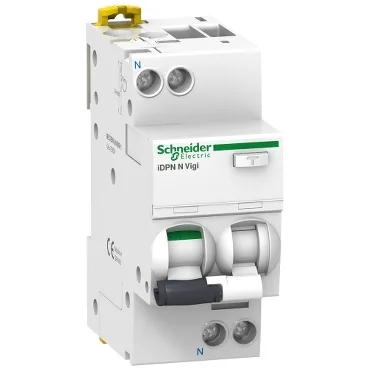
The integrated 300 mA earth-leakage sensitivity is set for equipment protection rather than personnel shock prevention — 30 mA units are the human-safety standard; 300 mA guards against insulation faults that could cause fire or equipment damage in distribution subcircuits. Breaking capacity is 6000 A Icn at 230...240 V AC, 50 Hz, certified to EN/IEC 61009-2-1. That is the standard residential and light-commercial fault level in most European installations; for industrial panels with higher prospective fault current you would step up to a 10 kA or 25 kA device. The thermal-magnetic trip unit gives a standard time-current curve — no electronic adjustment, so it is a fit-and-forget protective device for fixed-distribution outgoers. Mechanical and electrical endurance are both rated at 20000 cycles, which is typical for a DIN-rail mounted MCB/RCCB in distribution duty — adequate for a panel that sees occasional switching, not for a machine that cycles every few minutes.
Terminals accept 1 to 16 mm² rigid or 1 to 10 mm² flexible (with or without ferrule); strip length is 15 mm, tightening torque 2 N.m. That covers most panel-building wire sizes up to a 16 mm² feed. IP20 on the body, IP40 inside a modular enclosure — standard for distribution boards where the enclosure provides the outer seal.