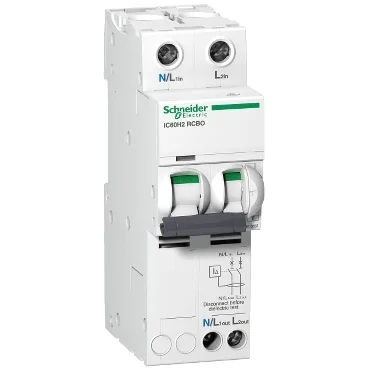
The Schneider Electric A9D51232 is an Acti9 iC60 RCBO — a residual current breaker with overcurrent protection in a 2-pole, 36 mm wide package that clips onto a DIN rail. It combines a C-curve thermal-magnetic MCB for overcurrents with integrated earth-leakage protection at 300 mA sensitivity, all in one unit that saves a module of space compared to separate devices. Rated 32 A at 50 °C, with a breaking capacity of 10 000 A Icn at 240 V AC (IEC 61009-1), it handles the sort of lighting, socket-outlet, or small-load final circuits you see in commercial and residential distribution boards.
In a panel where the prospective short-circuit current (PSCC) at the outgoer is under 10 kA, this device is a clean fit. If your supply transformer is close and the PSCC exceeds that, you'd need to step up to a higher-rated unit or add a current-limiting upstream breaker. The 300 mA earth-leakage sensitivity is a protection against fire risk from persistent arcing faults, not personnel shock protection (that's 30 mA and below). It's typical for circuits feeding equipment with natural leakage — heaters, computers, or fixed appliances — where a 30 mA RCD would nuisance-trip. For socket-outlet circuits where people touch the load, you'd want 30 mA; this 300 mA is for distribution or fixed-load outgoers. Depth of 75.5 mm and width of 36 mm (4 x 9 mm pitches) matter when you're laying out a high-density distribution board. That 75.5 mm is the dimension behind the panel face — the space the RCBO occupies inside the enclosure. If your gland plate or busbar shroud is tight, that's the number to check against your enclosure depth, not the 110 mm height.
Terminals are screw-clamp: top accepts 1…25 mm² rigid or 1…16 mm² flexible; bottom accepts 1…16 mm² rigid or 1…10 mm² flexible. Wire stripping length is 13 mm for the bottom connection and 14 mm for the top — enough to get a good bite in the screw clamp without leaving bare copper exposed past the terminal.