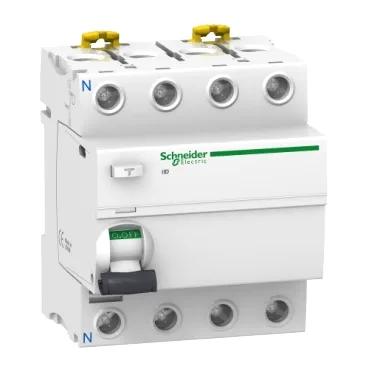
The Schneider Electric A9R52440 is a 4-pole residual current circuit breaker (RCCB) from the Acti9 iID family, rated at 40 A with 30 mA earth-leakage sensitivity. The part is listed as current-production — still an active catalog line, not a phase-out or NRND item.
Type AC detection means it trips on sinusoidal AC residual currents only — suitable for general-purpose circuits with resistive, inductive, or simple electronic loads, but not for pulsed DC or mixed-frequency waveforms from VFDs or switched-mode supplies. Breaking and making capacity is rated at Idm = Im = 1500 A. That is the short-circuit withstand capability of the RCCB itself — adequate for most final sub-circuits where an upstream MCB or fuse provides the actual fault interruption. The 250 A surge current rating (8/20 µs impulse) means it survives lightning-induced or switching transients without nuisance tripping. Pollution degree 3 per IEC 61008-1 means the device is rated for the conductive-pollution environment typical inside an industrial control panel or distribution board — not just clean residential switchgear. The IP20 finger-safe terminals are standard for enclosed panels; the IP40 rating on the modular enclosure applies when the device is mounted in a compatible Acti9 enclosure.
Clip-on DIN rail mounting, neutral on the left, toggle control with a contact-position indicator. Terminals accept 1...35 mm² rigid or 1...25 mm² flexible conductors; wire stripping length is 14 mm. The padlocking option allows lockout/tagout on the toggle for safe isolation during maintenance.
Sourcing and compliance posture
Compliance documentation covers GB 16916.21 and EN/IEC 61008-1. The RCCB is voltage-independent in its tripping technology, meaning it does not require a separate power supply or electronic circuit to detect a ground fault and open the contacts. That makes it a direct replacement for older electromechanical RCCBs in retrofit or BOM-freeze scenarios.