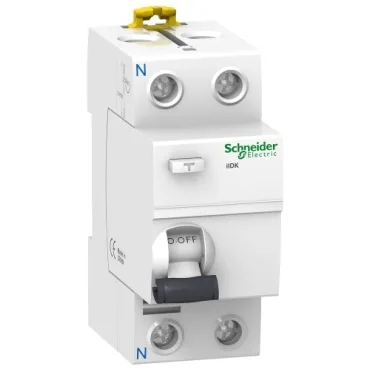
The Schneider Electric A9R75240 is a 2-pole residual current circuit breaker (RCCB) from the Acti9 iID K series, rated at 40 A with 300 mA earth-leakage sensitivity. It operates on 220-240 V AC networks at 50/60 Hz and uses voltage-independent tripping, meaning it detects leakage current and disconnects even if the supply voltage is lost — a key safety feature for personnel protection in grounded systems. For circuits with pulsed DC or variable-frequency drives, a Type A or Type B RCCB would be required.
The 40 A rated current (In) and 300 mA sensitivity are the two numbers that decide whether this RCCB fits a given circuit. The 40 A rating matches a typical 40 A feeder or submain; the 300 mA sensitivity is a fire-protection level (not personal shock protection, which requires 30 mA or lower) and is common for distribution boards feeding fixed equipment where nuisance tripping from cable capacitance must be avoided. Breaking capacity is rated at Idm 500 A / Im 500 A — this is the short-circuit withstand of the RCCB itself. It is not a high-fault device; upstream protection (MCB or fuse) must coordinate to clear faults above 500 A before the RCCB is damaged. The insulation voltage (Ui) is 440 V AC, and operational voltage (Ue) is 220-240 V AC — standard single-phase or line-to-neutral on a 230/400 V three-phase system.
The compact 2-module width saves space in crowded enclosures. Tunnel-type terminals accept 1-35 mm² rigid or 1-25 mm² flexible cable. The padlocking device allows lockout/tagout for maintenance isolation.
Mechanical durability is 5000 cycles; electrical durability under AC-1 resistive load is 2000 cycles. For a distribution-board RCCB that is rarely operated under load, this is adequate for a typical installation lifetime.