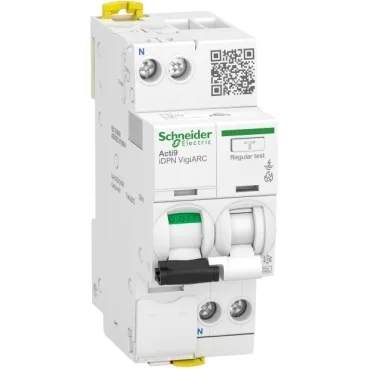
The integrated earth-leakage protection eliminates the need for a separate RCCB upstream, saving one DIN module in the panel. Trip technology is thermal-magnetic for overcurrent and an electronic core-balance transformer for residual currents — both in the same 36 mm-wide housing.
For a panel fed by a transformer rated below 50 kVA, or a distribution board with a known SCCR under 10 kA, this unit provides adequate interruption without requiring a current-limiting upstream breaker. Limitation class 3 per AS/NZS 61009.1 means it limits let-through energy effectively, reducing stress on downstream wiring. Rated current 10 A. Power loss per pole is 2.2 W. Electrical durability is 20,000 cycles under load at 240 V AC; mechanical durability matches at 20,000 cycles. For frequent switching applications (e.g., lighting control), this is adequate but not unlimited — factor in the cycle count for the expected service life.
Clip-on mounting to DIN rail. Neutral on the left. Cable entry top and bottom. IP20 finger protection on the front; the terminals are not touch-safe when open — standard for DIN-rail devices. Pollution degree 2 (non-conductive pollution only) covers typical indoor panel environments. Tropicalisation severity B per IEC 60068-2-30 means the unit withstands 28 days of cyclic damp heat (95% RH at 55 °C). For panels in coastal or high-humidity environments, this provides a margin against internal condensation corrosion.
Standards compliance includes EN/IEC 62606 (residual current device with overcurrent protection) and AS/NZS 61009.1 (Australian/New Zealand variant). RCM quality label covers Australian regulatory market access.