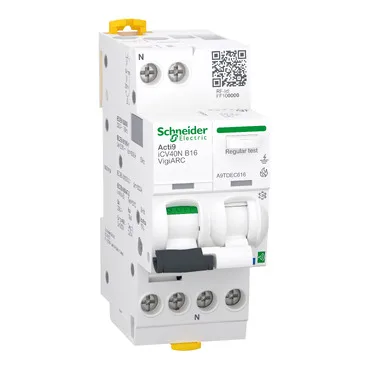
Rated 16 A with a B curve, it breaks up to 6 kA Icn (service) and 10 kA Icu (ultimate) at 230 V AC, 50 Hz — enough to clear a bolted fault on a residential or light-commercial final subcircuit without upstream coordination issues.
The 16 A rated current and B curve mean the device trips magnetically between 3 and 5 times In (48–80 A) — standard for resistive and general-purpose loads like lighting, socket outlets, and small appliances. The 1P+N configuration switches the line and monitors the neutral; the neutral is left, which matches the standard Acti9 busbar layout. The 6 kA Icn (EN/IEC 61009-2-1) is the service breaking capacity for an RCBO-type device; the 10 kA Icu (EN/IEC 60947-2) is the ultimate breaking capacity under the industrial standard, giving headroom for higher fault-current locations. The thermal-magnetic trip unit handles overloads (thermal) and short-circuits (magnetic). The arc-fault detection (AFDD) adds series and parallel arc detection per EN/IEC 62606, which is what distinguishes this from a standard RCBO — it catches glowing connections and carbonised insulation faults that a thermal-magnetic element alone might miss.
The toggle control gives local ON/OFF switching plus a fault-trip LED and arc-fault diagnostic indicator.