The 25 A rated current (In) and 30 mA residual sensitivity define the circuit it can protect: a 25 A final subcircuit supplying lighting, socket outlets, or small appliances, with the 30 mA threshold providing personnel protection against indirect contact. The earth-leakage protection is Type A-SI (Super Immunised), meaning it is immune to nuisance tripping from high-frequency leakage currents generated by modern switched-mode power supplies or variable-speed drives — a common pain point in commercial fit-outs. Arc-fault detection conforms to EN/IEC 62606, while the residual current portion meets EN/IEC 61009-1 and EN/IEC 61009-2-1. The device is voltage-independent for residual current tripping, so it still clears an earth fault even if the line voltage collapses — a reliability advantage for circuits where a lost neutral could otherwise mask a fault. Electrical durability is rated at 10,000 cycles above 25 A and 20,000 cycles at or below 25 A; mechanical durability is 20,000 cycles. For a typical residential final circuit switched a few times per week, this translates to decades of service life. The local signalling includes ON, OFF, and fault-trip LED with arc-fault diagnostic, which helps a commissioning engineer identify the cause of a trip without additional test gear.
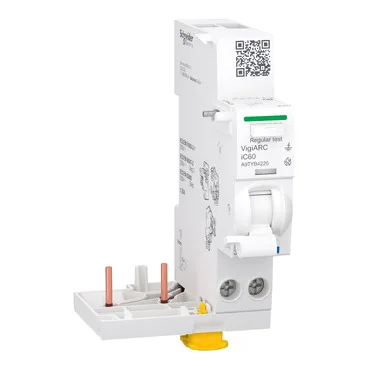
Schneider Electric A9TYB4225 Acti9 VigiARC iC60, 25 A, 30 mA
Schneider Electric Acti9 VigiARC iC60, arc-fault detection with residual current protection add-on block, 2P, 25 A, 30 mA, 230 V AC, DIN rail.
Specifications
| Parameter | Value |
|---|---|
| Earth-leakage sensitivity (IΔn) | 30 mA |
| Earth-leakage protection class / type | Type A-SI (Super Immunised) |
| Earth-leakage trip time delay | Instantaneous |
| Residual-current tripping technology | Voltage independent |
| Local signalling / indication | ON, OFF, fault trip LED arc fault diagnostic |
| Parameter | Value |
|---|---|
| Rated current (In) | 25 A |
| Rated operational voltage (Ue) | 230 V AC |
| Poles description | 2P |
| Neutral pole position | Left |
| Network type | AC |
| Network frequency | 50 Hz |
| Rated insulation voltage (Ui) | 250 V AC |
| Rated impulse withstand voltage (Uimp) | 4 kV |
| Device location in system | Outgoer |
| Electrical durability | 10000 cycles > 25 A 20000 cycles <= 25 A |
| Mechanical durability (operating cycles) | 20000 cycles |
| Parameter | Value |
|---|---|
| Product name | Acti9 VigiARC iC60 |
| Product / component type | Arc fault detection with residual current protection add-on block |
| Device short name | VigiARC iC60 |
| Parameter | Value |
|---|---|
| Mounting support | DIN rail |
| Mounting mode | Clip-on |
| Width in 9 mm modules | 2 |
| Terminal connections | Tunnel type terminals1...10 mm² flexible Tunnel type terminals1...16 mm² rigid |
| Wire stripping length | 14 mm |
| Terminal tightening torque | 2 N.m |
| Width | 54 mm |
| Height | 91 mm |
| Depth | 73 mm |
| Parameter | Value |
|---|---|
| Operating ambient temperature | -25...40 °C |
| Storage ambient temperature | -40...80 °C |
| IP degree of protection | IP20 conforming to IEC 60529 |
| Pollution degree | 2 |
| Operating altitude | 2000 m |
| Tropicalisation | Severity B conforming to IEC 60068-2-30 for 28 d |
| Parameter | Value |
|---|---|
| Standards | EN/IEC 62606 EN/IEC 61009-1 EN/IEC 61009-2-1 |
Product details
Frequently asked questions
What compliance standards does the A9TYB4225 meet?
The A9TYB4225 complies with EN/IEC 62606 (arc-fault detection), EN/IEC 61009-1, and EN/IEC 61009-2-1 (residual current operated circuit-breakers). It carries IMQ quality label and is tropicalised to severity B per IEC 60068-2-30 for 28 days.
Where can I buy the A9TYB4225?
The A9TYB4225 is sourced and quoted to order against an RFQ through independent distribution. Availability and current pricing are confirmed at quote time.
What is the difference between the A9TYB4225 and a standard RCBO?
The A9TYB4225 adds arc-fault detection (AFDD) per EN/IEC 62606 on top of the residual current protection. A standard RCBO only provides overcurrent and earth-leakage protection; it does not detect series or parallel arcing faults that can cause electrical fires even below the overcurrent trip threshold.