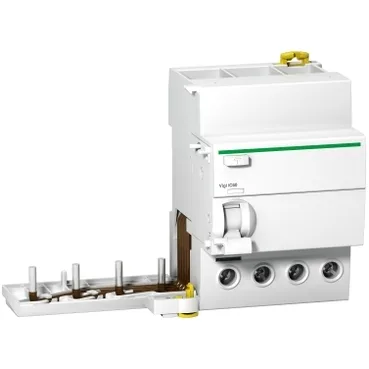
It provides earth-leakage protection for a 4P circuit rated at 63 A continuous current, with a 300 mA sensitivity and Type A waveform recognition — meaning it trips on sinusoidal AC residual currents and pulsating DC residual currents, which covers most modern electronic loads like variable-speed drives, switched-mode power supplies, and rectifiers. The instantaneous trip characteristic (no intentional time delay) ensures fast disconnection on fault, making it suitable for final subcircuits where selectivity with upstream delayed RCDs is managed by grading, not by this device itself. The voltage-independent trip technology means the RCD does not rely on the supply voltage or an external power source to operate — the fault current itself provides the energy to trip, which is a safety advantage if the neutral is lost or the voltage collapses during a fault. This is a key distinction from electronic RCDs that require a power supply to function.
The unit occupies 7 modules of 9 mm pitch, so 63 mm of DIN rail width. Dimensions are 135 mm wide × 91 mm high × 74 mm deep. The electrical connection to the MCB is made by screws, so verify the iC60 double-terminal accessory is present on the breaker before assembly. IP20 per IEC 60529 for the device body; IP40 when enclosed in a modular enclosure. Storage temperature range -40…85 °C, operating -25…60 °C.
Designed and certified to IEC 61009-1 and EN 61009-1, the harmonized standard for residual current operated circuit breakers with integral overcurrent protection (RCBOs) — though this unit is an add-on RCD, not a combined RCBO. The impulse withstand rating is 250 A at 8/20 µs waveform per IEC 61009-1. Rated insulation voltage 500 V AC; rated impulse withstand voltage 6 kV per IEC 60947-2. These standards ensure the device meets European and international installation codes for residual current protection.