Lifecycle status — obsolete, sourced to order
The A9W21263 is marked obsolete by Schneider Electric. For current BOM lines that specify this exact Acti9 Vigi iC60 2P 63A 30mA Type A add-on RCD, supply is through independent distribution — quoted to order against an RFQ, with availability and pricing confirmed at quote time.
What it is — Acti9 Vigi iC60 add-on RCD
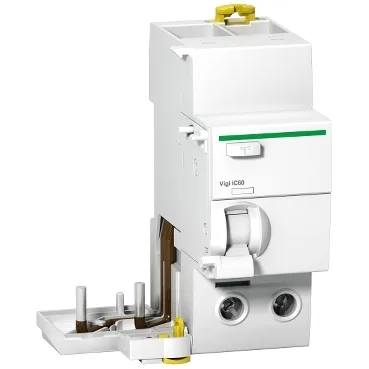
The A9W21263 is a voltage-independent residual current device (RCD) from the Acti9 Vigi iC60 range. It clips onto the side of a compatible Acti9 iC60 MCB to add earth-leakage protection in a single modular width. Rated 63 A with 30 mA sensitivity, Type A (pulsating DC and sinusoidal AC fault detection), it sits downstream as an outgoer device in a 230/400 V AC 50/60 Hz network. The 30 mA sensitivity is the standard threshold for personnel protection against electric shock in residential and commercial final circuits. Type A detection covers the waveform shapes most common in modern electronics — single-phase rectified loads, switched-mode supplies, and variable-speed drives — so it is the default choice for mixed-load panels where pure sinusoidal (Type AC) would miss pulsating DC leakage.
The 2P (two-pole) form factor matches a 2P MCB side-by-side. Tunnel-type terminals accept up to 35 mm² rigid or 25 mm² flexible cable; strip length is 14 mm, tightening torque 3.5 N·m. IP20 finger-safe on the front, IP40 inside a modular enclosure. Depth of 74 mm and height of 91 mm fit standard distribution board cutouts. The trip indicator gives a local visual of RCD status — useful during fault isolation without breaking the seal.
Protection ratings and standards compliance
The 8/20 µs impulse withstand of 250 A (IEC 61009-1) means it survives common surge events without nuisance tripping. Instantaneous tripping (no intentional delay) provides fast disconnection for shock protection. Compliant with EN 61009-1 and IEC 61009-1 — the harmonized European standard for RCBOs and RCDs with integral overcurrent protection. The voltage-independent tripping mechanism means the RCD operates even if the neutral is lost, a safety advantage over electronically tripped units.