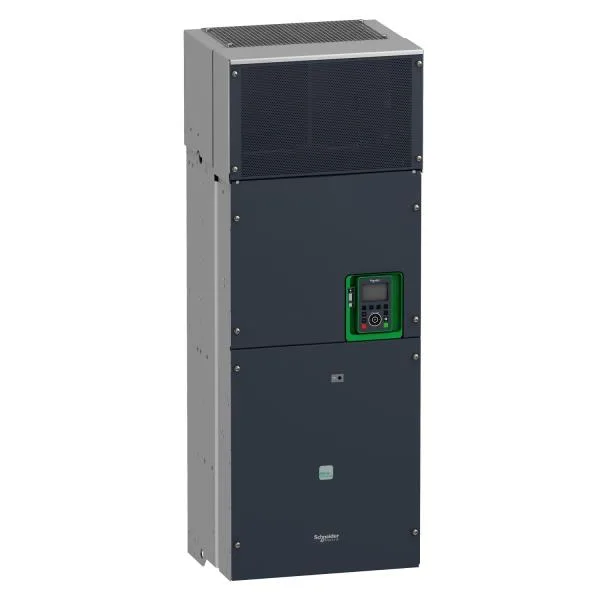
Where the ATV930 drives a load
The ATV930C22N4MN is a Square D sensorless vector control drive listed at 350 Hp, the kind of unit wired into a 460 V motor feeder to run a heavy-load machine — a large pump, a compressor bank, a bulk-material conveyor — without a shaft-mounted encoder on the motor face. Sensorless vector control on this class means the drive derives rotor position from motor current and voltage rather than from a feedback device, so the cabinet stays free of an encoder run-back and the commissioning steps reduce to nameplate data entry plus an auto-tune.
Reading the line on the nameplate
The line's listed sub-category is Sensorless Vector Control Drive, with UPC 606481280261 on the label — that UPC ties the unit back to the manufacturer's catalog record for receiving inspection and for cross-checking the PO against what physically lands on the dock.
Panel-side fit and what to plan for at install
A 350 Hp drive in this class typically needs a dedicated MCC section with top or bottom cable entry for the line and load conductors, separately routed control wiring for the command interface, and clearance above and below the heatsink rated to the drive's continuous-current thermal output — the install drawing sets the envelope, not the bare Hp figure. Sensorless vector operation imposes a motor-parameter set that the installer enters at first power-up; the drive will not run a motor it has not auto-tuned, so the commissioning step is mandatory rather than optional and should be scheduled with the motor uncoupled if the application allows it.
Sourcing the unit through the order
With the lifecycle line reading current, the ATV930C22N4MN is typically specified into the BOM and ordered against the exact part string — the relevant quote is project-quantity pricing and lead time on a per-RFQ basis, not a generic catalog pull. Independent distribution carries the unit alongside the manufacturer's own channel; the practical question at RFQ is whether the quantity, the firmware revision, and the option-card stack match what the panel drawing calls for, since those are the items that fail a receiving inspection rather than the Hp label.