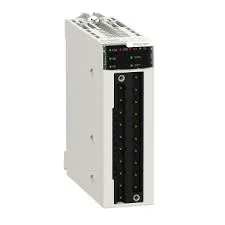
The Schneider Electric BMXETM0200H is a frequency module in the Modicon X80 I/O family, with current lifecycle status, sized to measure speed and frequency on turbo machines. It is a standard-format, high-speed input / reflex digital output module built around two channels, accepting 2 MPU inputs and 2 APU inputs and delivering 2 outputs on a 28-pin front connector.
Why a 1 ms cycle time matters here
Cycle time is 1 ms with a 0.2 ms overlap and a built-in compare function, which is what lets the module keep pace with fast-shaft pulses rather than just count them slowly — the gating figure for any closed-loop overspeed or speed-match scheme on a turbo. Input frequency span is 0...500 kHz on the high-speed inputs, with current draw held to <= 30 mA at 24 V DC from the sensor rail, so the slot does not distort the backplane budget when an encoder or magnetic pick-up is wired in.
Encoder / pick-up compatibility and output envelope
The inputs accept 19.2...30 V incremental encoders, active pick-up sensors, and 10...30 V totem-pole magnetic pick-up sensors, with MPU input range 0.3...100 V AC and APU input range 2.5...30 V DC — so both legacy magnetic pickups and modern 24 V incremental encoders land on the same wiring block. Input voltage limits are 19.2...30 V at 60 °C and 26.4 V at 70 °C, while the reflex outputs deliver 24 V DC source logic with a maximum load of 1 A per module and 0.5 A per output, voltage drop <3 V at state 1, and 1.5 A integrated short-circuit protection per output. State discrimination is sharp: voltage state 0 guaranteed <0.3 V with 0.1 mA leakage at state 0, voltage state 1 guaranteed across the MPU and APU ranges above — useful when the reflex output is feeding a turbine controller that demands deterministic thresholds.
Standards, environment, and isolation
The module is conformally coated and rated to IEC 61131-2, IEC 61010-2-201, UL 61010-2-201, CSA C22.2 No 61010-2-201, IACS, IEC 61000-6-5 interface type 1 and type 2, IEC 61850-3 location G, and IEC 60079-0, with isolation at 1400 V DC for 1 min field/bus or ground and 1000 V DC for 1 min on differential interfaces and input/output. Operating envelope is -25...70 °C with 10...95 % non-condensing humidity and IP20 on the housing, and the part is qualified for gas, dust, sand, salt, mold, and fungal exposure per IEC 60721-3-3 classes plus hazardous location Class I Division 2 — the rating that lets it sit inside a turbine cabinet. EU directives covered are 2014/35/EU low voltage, 2014/30/EU electromagnetic compatibility, and 2014/34/EU ATEX, which is the paperwork set a turbine skid build typically asks for at the gate review.