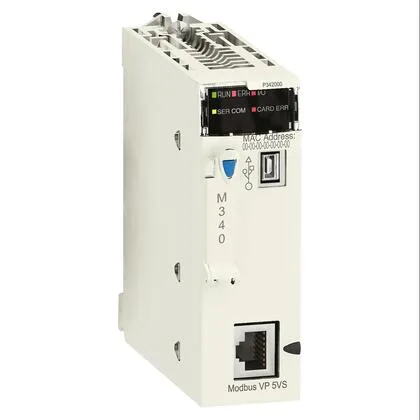
What it is on the rack
The Schneider BMXP342000 is a processor module for the Modicon M340 automation platform — the standard-performance Modbus-capable CPU slot for a BMXRack-style chassis, fed by internal power supply via the rack backplane rather than a separate 24 V feed. Capacity is 1024 discrete I/O plus 256 analog I/O, spread across up to 4 racks, with a 36-channel application-specific allotment and headroom for 2 Ethernet communication modules or 4 AS-Interface modules alongside the processor. IP20 footprint, TC conformal coating, and lifecycle status current are the values on record.
Modbus and serial on the front face
Four physical interfaces sit on the processor: an RS-232C character-mode port (RJ45, 2 twisted shielded pairs, full duplex), an RS-485 character-mode port (RJ45, 1 twisted shielded pair, half duplex), a Modbus master/slave port on RS-232C, and a Modbus master/slave port on RS-485, each Modbus segment tunable 0.3...19.2 kbit/s. A USB 12 Mbit/s port is also exposed on the face. Modbus framing covers both RTU (1 CRC per frame) and ASCII (1 LRC per frame), with the same LRC pair also available in plain character mode. Per-request payload is 252 data bytes in RTU, 504 in ASCII, and 1 K data byte in plain character mode; address span 0...248 in either mode. Bus length is class-of-isolation, not just baud: non-isolated segments run 0...10 m, isolated segments run 0...1000 m, and a point-to-point link stays under 15 m. Tap links on an isolated Modbus segment are capped below 40 m. 0...32 devices share a segment in either mode. Diagnostic counters and Modbus event counters are exposed on the module, and the front-panel LED set covers RUN, I/O fault, CARD ERR, ERR, and a yellow SER COM activity light on the Modbus port.
Program, scan, and task structure
Memory layout is 4096 kB internal RAM split as 256 kB data plus 3584 kB program/constants/symbols, with a BMXRMS008MP memory card handling program, constant, symbol, and data backup. Default object areas are 1024 %MWi internal words, 256 %KWi constant words, and 512 %Mi located internal bits; the maxima climb to 32634 %Mi, 32464 %MWi, and 32760 %KWi. Throughput is rated 4.2 Kinst/ms at a 65 % Boolean / 35 % fixed-arithmetic mix, or 5.4 Kinst/ms at 100 % Boolean. Per-instruction execution lands at 0.18 µs Boolean, 0.38 µs single-length words, 0.26 µs double-length words, and 1.74 µs floating point. System overhead is 0.2 ms on the fast task and 1.05 ms on the master task. Scheduling is 1 cyclic/periodic master task, 1 periodic fast task, no auxiliary task, and 32 event tasks — enough headroom for typical line control without dragging in a high-end CPU.
Power, environment, and panel-side handling
The processor draws 72 mA at 24 V DC from the rack. Operating ambient is 0...60 °C, with 5...95 % relative humidity non-condensing. Conformal coating (TC) and the IP20 enclosure rating suit standard cabinet mounting; the module expects to be seated in a controlled panel, not a washdown field enclosure.
Markings, directives, and the decl pack
Markings carried on the product are CE, UL, CSA, RCM, EAC, UKCA, China RoHS, WEEE, and IEC, and the directives listed are 2014/35/EU (low voltage), 2014/30/EU (EMC), and 2012/19/EU (WEEE). Standards on the data sheet line up with IEC 61131-2, IEC 61010-2-201, UL 61010-2-201, CSA C22.2 No 61010-2-201, IACS, and the EMC clauses EN/IEC 61000-6-5 (interface type 1 and type 2) and EN/IEC 61850-3 location G. That set is what shows up on the declaration of conformity and is the basis for site acceptance in industrial and substation-adjacent cabinets.