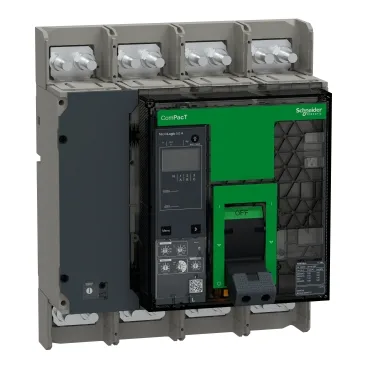
What the 630 A and 150 kA ratings mean for your distribution board
That 630 A is the continuous current the MicroLogic 5.0 A electronic trip unit can carry without derating at 50 °C ambient — size your upstream transformer and busbar for at least that. The 630 A rating, combined with the 150 kA breaking capacity, makes this unit suitable for high-fault service-entrance or main-switchboard positions where fault currents are severe.
Trip unit and protection profile — L, S, I curves
The MicroLogic 5.0 A trip unit provides three protection functions: L (long-time overload), S (short-time short-circuit with selectable delay for selectivity), and I (instantaneous short-circuit). The L curve handles overloads up to the 630 A rating; the S curve lets you coordinate downstream breakers so only the faulted branch trips; the I curve catches hard shorts. The electronic trip unit also includes a thermal memory of 20 minutes — after a trip, the breaker remembers the heat rise and will re-trip sooner if reclosed into a still-hot circuit, which matters for motor or transformer starts that draw high inrush. The ammeter display shows real-time load current on the LCD, useful during commissioning to confirm phase balance.
Mounting and integration — fixed backplate, 70 mm pitch
Mounting is fixed to a backplate — no DIN-rail adapter, so plan for drilled and tapped panel mounting. The connection pitch is 70 mm, which matches standard Schneider busbar systems for the ComPacT NS range. Both upside and downside connections are front-accessible, so the breaker can be wired without rear access to the panel. At 327 mm high, 280 mm wide, and 147 mm deep, it needs a cutout and clearance for the front LCD and handle swing.
Durability and power loss
Mechanical endurance is 10,000 cycles; electrical endurance depends on the load current — 2,000 cycles at full 630 A / 690 V, 3,000 cycles at half current. That is typical for a fixed MCCB in distribution duty where it operates infrequently (a few times a year for maintenance switching). Power loss is 15 W at rated current — negligible for panel ventilation but worth including in thermal calculations for a sealed enclosure. The manually operated control type means no motor operator or shunt trip is integrated; those can be added as accessories if remote tripping is needed.