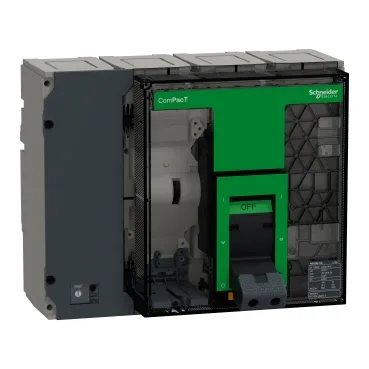
It carries a 630 A continuous rating in AC-23A duty across the full voltage range (220 V to 690 V AC). Built to IEC 60947-3, it is certified as a switch-disconnector with a visible break indicator and suitability for isolation — so it doubles as a lockable service disconnect, not just a load-break switch. The 8 kV rated impulse withstand voltage and pollution degree 3 rating mean it is designed for industrial environments where transient surges and conductive dust are expected.
The 630 A AC-23A rating is the headline number — it governs motor switching duty (making and breaking motor loads, including occasional inrush). The same 630 A figure holds at 220/240 V, 380/415 V, 440/480 V, 500/525 V, and 660/690 V, so you do not lose capacity at higher voltages. The conventional free-air thermal current (Ith) is also 630 A at 60 °C, which is the thermal limit for continuous current in an open panel. Short-circuit performance: rated short-time withstand current (Icw) is 25 kA for 0.5 s, and the rated short-circuit making capacity (Icm) is 52 kA at 690 V. That means the switch can close onto a fault up to 52 kA peak and hold 25 kA for half a second while upstream protection clears — critical for selective coordination in a distribution board. Mechanical durability is 10,000 cycles; electrical durability is 2,000 cycles at 440 V. For a manually operated disconnect used as a service switch (not daily production cycling), that is a long service life. The IP40 enclosure protection keeps tools and fingers out but is not rated for washdown — this is a panel-interior or enclosed disconnect, not a standalone outdoor unit.
Dimensions are 327 mm wide × 280 mm high × 147 mm deep — fits a standard 800 mm wide enclosure with room for side cable ducts. The IK07 impact rating means it survives panel-door bumps during commissioning. That covers unheated electrical rooms and outdoor enclosures in most climates, though the IP40 rating means the enclosure itself must provide weather protection.