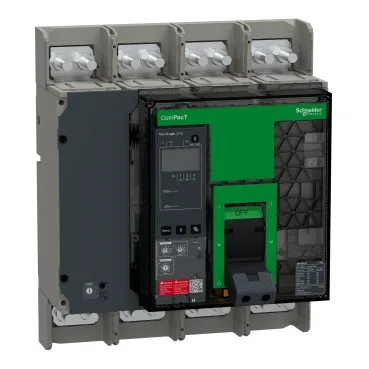
The C100H42EFM is a Schneider Electric ComPacT NS new generation 4-pole molded case circuit breaker with a MicroLogic 2.0 E electronic trip unit, rated 1000 A at 50 °C. It's built for distribution duty — EN/IEC 60947-2 compliant, Category B utilisation, meaning it's fully rated for selectivity in a main or feeder position, not just a branch device. Breaking capacity is the headline: 85 kA Icu at 220/240 V AC, 70 kA at 380/415 V, 65 kA at 440 V, 50 kA at 500/525 V, and 42 kA at 660/690 V — all per IEC 60947-2. That H-code rating (70 kA at 415 V) puts it in the high-fault tier for industrial switchboards where upstream transformer capacity or motor contribution drives the available fault current. The MicroLogic 2.0 E provides L (long-time overload) and I (instantaneous short-circuit) protection curves, plus an energy meter built into the trip unit — useful for submetering a feeder without an extra panel meter. Thermal memory holds for 20 minutes after a trip, so repeated overloads accumulate correctly per the thermal model.
Fixed mount on a backplate, with front-facing connections both upside and downside. Connection pitch is 70 mm, which matches standard busbar or cable lug spacing for this frame size. Neutral is on the left, so plan your busbar layout accordingly — it's not reversible without a kit. Dimensions: 327 mm high, 280 mm wide, 147 mm deep. Local signalling uses four red LEDs for fault indication (phase-specific) and one yellow LED for overload pre-alarm. The LCD display on the trip unit shows measured values and settings — no external display module needed for basic metering.
1000 A at 50 °C is the continuous current rating with the MicroLogic 2.0 E trip unit. That's the maximum load you can run without tripping on long-time protection. If your ambient hits 50 °C in the switchroom, you're at the limit — no derating needed at that temperature, but above it you'll need to apply the manufacturer's temperature derating curve. Power losses are 22 W at rated current — that's the heat dissipated by the breaker itself. Mechanical durability is 10,000 cycles, electrical durability varies by load: 2,000 cycles at 690 V full load, 4,000 at half load, and up to 6,000 at 440 V half load. That's typical for a distribution breaker — not designed for frequent switching like a contactor, but fine for infrequent isolation or backup switching.