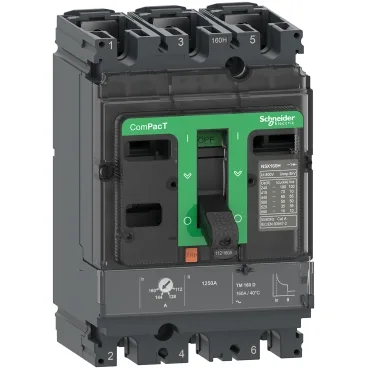
What the 85 kA breaking capacity means for your panel
At the more common 415 V AC distribution level, the breaking capacity is still a substantial 36 kA Icu, which gives you headroom for high-fault panels without cascading an upstream breaker. The 3-pole (3P) configuration and front-front connection suit it for panelboard or switchboard mounting on a backplate.
Trip curve and protection logic
The TM-D trip unit provides L (thermal) protection for overloads and I (magnetic) protection for short circuits. The thermal element tracks RMS heating in the conductor; the magnetic element responds instantaneously to high-current faults. This is a Category A breaker — no intentional short-time delay, so it trips fast on a hard fault, which simplifies coordination with downstream devices. The 16 A rating at 40 °C means you size it for a continuous load not exceeding that value at that ambient; derate for higher enclosure temperatures per the IEC 60947-2 thermal curve.
Dimensions are 161 mm high by 105 mm wide by 86 mm deep. Operating altitude is 0 to 2000 m without derating; above 2000 m up to 5000 m requires derating of the dielectric and thermal performance.
Electrical endurance and power dissipation
Mechanical durability is rated at 50,000 cycles. Electrical durability depends on the switched current: 50,000 cycles at 440 V at half rated current (In/2), 30,000 cycles at 440 V at full In, 20,000 cycles at 690 V at In/2, and 10,000 cycles at 690 V at full In. Power dissipation is 2.92 W per pole, so the three-pole breaker dissipates about 8.76 W total under rated load — factor that into your enclosure thermal budget.