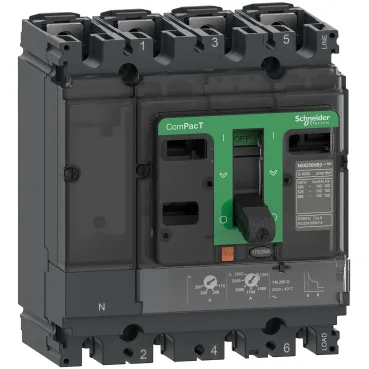
It is a 4-pole unit (4P) designed for AC distribution networks at 50/60 Hz, with toggle control and front-front connections. The H breaking capacity code means 70 kA Icu at 380/415 V AC per IEC 60947-2, stepping down to 65 kA at 440 V and 35 kA at 525 V — enough for most commercial and light industrial main or feeder panels. The thermal element tracks RMS heating in the conductor; the magnetic element responds to instantaneous overcurrents. Neutral protection is set at 1 x Ir (4D), meaning the neutral pole tracks the phase protection level — common for 4-pole distribution where the neutral is not reduced in size. There is no built-in earth-leakage protection; add a Vigi module externally if ground-fault detection is required.
Breaking capacity — what the H code means for your panel
For UL 60947-4-1 applications, the ratings are 85 kA at 240 V AC and 65 kA at 480 V AC. The utilization category is A, so it is not intended for frequent switching of motor loads under load — that is category B territory.
Mounts on a backplate — not a DIN rail — so panel layout requires a drilled or tapped mounting surface. The breaker accepts horizontal or vertical orientation and flat-on-back mounting.
Durability and environmental limits
Mechanical durability is rated at 50,000 cycles; electrical durability varies with load: 50,000 cycles at 440 V at half rated current (In/2), 30,000 at full In, 20,000 at 690 V In/2, and 10,000 at 690 V full In. Operating altitude is 0–2000 m without derating; above that up to 5000 m requires derating per the manufacturer's curve. Relative humidity range is 0–95% non-condensing. The breaker carries an IK07 impact rating (2 J impact energy) per IEC 62262, meaning it withstands accidental tool strikes during panel work.