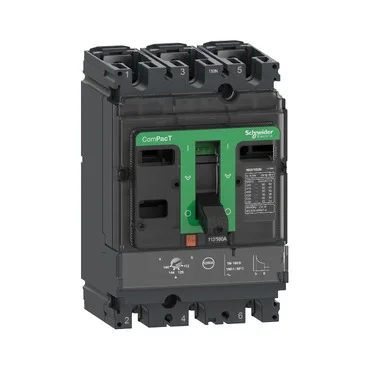
For a 25 A load, this means the thermal element tracks I²t heating in the conductor, while the magnetic element responds instantaneously to fault currents above a preset threshold — no earth-leakage module is built in. Breaking capacity is the headline selector: 90 kA Icu at 240 V AC, 50 kA at 415 V, 36 kA at 500 V, and 10 kA at 690 V. The N code means 50 kA at 415 V — this is the rating that governs most 400 V-class distribution panels. If your fault-current study shows available short-circuit current above 50 kA at the breaker's line side, you need a higher-frame (S or H) NSX variant. Below that, this unit clears faults safely without upstream cascading. Three poles protected (3D,), toggle control, front connections both sides. IP40 enclosure protection means it's suited for clean indoor panels — not washdown environments. Pollution degree 3 covers conductive pollution typical in industrial control rooms.
No UL or CSA listing appears in the evidence; if your panel requires UL 489, verify the specific variant or request the UL-marked order code.
Durability and thermal budget
Mechanical durability is 50,000 cycles. Electrical durability varies with load: 50,000 cycles at 440 V at half rated current (In/2), 30,000 at full In, 20,000 at 690 V In/2, and 10,000 at full 690 V In. These numbers matter for frequent-switching applications like motor circuits or capacitor banks — if your operation exceeds these, consider a contactor ahead of the breaker. Power dissipation is 4.01 W per pole. For a 3-pole breaker at full load, that's about 12 W of heat inside the enclosure. In a densely packed panel, this heat must be factored into the thermal design to avoid nuisance tripping or accelerated aging of adjacent components.