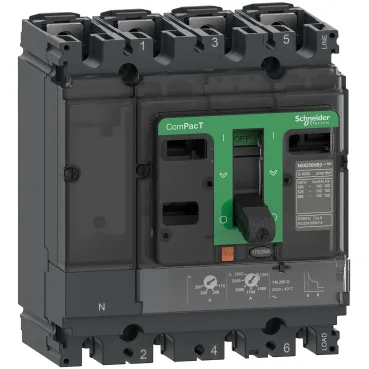
The 4-pole configuration suits three-phase systems with a switched neutral, common in European and Asian panel builds where the neutral must be isolated or protected.
Deployment context
The 140 mm width and 161 mm height fit standard distribution panel cutouts.
The interrupting rating varies by operating voltage, which is the key selection parameter for coordination studies. At 220/240 V AC the breaker delivers 90 kA Icu; at 380/415 V AC it's 50 kA; at 440 V AC it's 50 kA; at 500 V AC it drops to 36 kA; at 525 V AC it's 35 kA; and at 660/690 V AC it's 10 kA. Under UL 60947-4-1, the ratings are 85 kA at 240 V AC, 50 kA at 480 V AC, and 10 kA at 600 V AC. The 50 kA at 415 V AC is the most commonly cited figure for European 400 V distribution, but if your available fault current at the panel exceeds that at your system voltage, you need to step up to the NSX250 or NSX630 frame with a higher breaking capacity code.
Durability and endurance
Mechanical endurance is rated at 50,000 cycles. Electrical endurance depends on the switched current: 50,000 cycles at 440 V with half the rated current (In/2), 30,000 cycles at 440 V at full In, 20,000 cycles at 690 V at In/2, and 10,000 cycles at 690 V at full In. For a distribution breaker that sees infrequent switching (a few operations per day), these numbers represent decades of service life. The thermal-magnetic TM-D trip unit provides overload protection via a thermal bimetal (L protection) and short-circuit protection via a magnetic solenoid (I protection), with no electronic adjustments — it's a fixed-curve device, so coordination with downstream breakers must be verified against the published time-current curve.