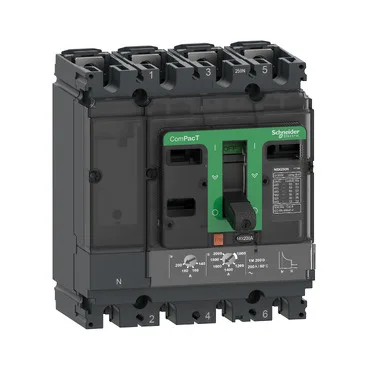
At 220/240 V the same breaker handles 90 kA Icu, so it also suits subpanels fed from a large transformer. The 4-pole configuration (4P) with neutral on the left and no integral earth-leakage module means it is a straight feeder or main breaker; add a Vigi module externally if ground-fault protection is required. The breaker is certified for isolation per EN/IEC 60947-2, which means the open contacts provide a visible-gap-equivalent disconnection — no need for a separate disconnect switch on the load side when this serves as the main panel breaker. The housing carries IP40 (tool-proof, no water jets) and IK07 impact resistance, so it withstands incidental knocks during panel wiring.
The toggle control is manual; no motor operator or rotary handle is integral, but the rotary handle accessory can be added for door-mounted operation.
Selectivity and coordination
The TM-D trip provides L (thermal overload) and I (magnetic short-circuit) protection. The 80 A rating at 50 °C means no derating is needed in a 40 °C panel ambient, but above 50 °C the trip threshold shifts per the IEC 60947-2 thermal curve. Electrical durability is 50,000 cycles at 440 V at half rated current, dropping to 30,000 cycles at full rated current — sufficient for infrequent switching (feeder or main duty), not for motor-starting duty where a contactor handles the switching. Mechanical durability is 50,000 cycles. For selectivity studies, the N breaking capacity at 415 V coordinates with downstream 10 kA or 18 kA MCBs; the 90 kA at 240 V handles the high-fault side of a step-down transformer.