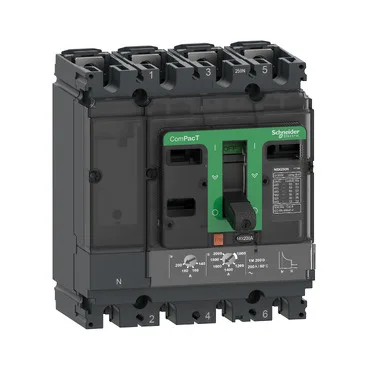
The TM-D provides L (thermal overload) and I (magnetic short-circuit) protection in a single block — no electronic adjustment, no add-on modules. That 40 A rating is at 50 °C ambient, so in a 40 °C panel it holds the full 40 A without derating; above 50 °C you follow the IEC 60947-2 thermal curve. Breaking capacity is where this part earns its place in the BOM. At 415 V AC — the most common industrial distribution voltage in Europe and Asia — it interrupts 50 kA Icu. That is an N-frame rating, meaning it handles the fault current typical of a transformer-fed main switchboard without cascading upstream. At 220/240 V it goes to 90 kA; at 690 V it drops to 10 kA. For a 40 A feeder, the 50 kA at 415 V gives ample headroom for most secondary distribution panels. The breaker is isolation-rated per EN/IEC 60947-2, so it serves as a visible disconnect in the panel.
The 4-pole body is 140 mm wide, 161 mm tall, and 86 mm deep, so it fits a standard 600 mm wide enclosure with room for side-mounted auxiliaries. IP40 front face (IK07 impact rating) is standard for a distribution panel — no gasket kit needed for dry indoor locations. The toggle handle protrudes about 25 mm past the front face; account for that in the door cut-out if the panel has a swing frame.
Mechanical endurance is 50,000 cycles — the standard for a distribution breaker that sees infrequent manual switching. Electrical endurance at rated current (40 A, 440 V) is 30,000 cycles; at half-rated current it doubles to 50,000 cycles. For a motor feeder that cycles once per shift, that is roughly 20 years of service before the contacts need inspection.