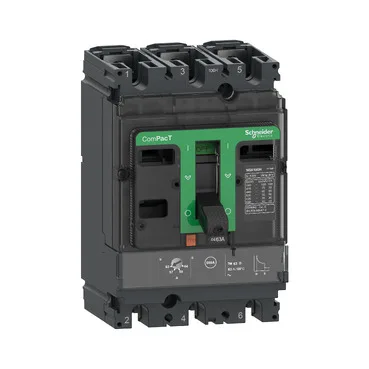
It's a 3-pole device in the H breaking-capacity class — 70 kA Icu at 415 V AC, 100 kA at 240 V — built for distribution panels where fault levels are high enough that a standard NSX frame would need an upstream current limiter. The TM-D trip gives you fixed thermal (L) and fixed magnetic (I) protection: overload curve shaped by a bimetal, short-circuit pickup by a solenoid, no interchangeable rating plugs.
The 80 A rating is at 50 °C ambient — if your panel runs hotter, you derate per the IEC 60947-2 thermal curve. The NSX160H frame accepts up to 160 A trip units, so this breaker is physically the same size as a 160 A version; the 80 A TM-D just sets the protection threshold lower. At 690 V the Icu drops to 10 kA, so verify your system voltage against the full table before committing the BOM line. Electrical durability is 40,000 cycles at 440 V at half rated current (In/2), 20,000 cycles at full In, and 7,500 cycles at 690 V at In/2. Mechanical durability is 40,000 cycles. For a distribution breaker these numbers are typical — it's not a contactor meant for frequent switching; it's a protective device that opens rarely. If your application cycles the breaker daily as a disconnect, factor the mechanical life into your PM schedule.
Mounts on a backplate — no DIN-rail clip on this frame size. The 105 mm width, 161 mm height, and 86 mm depth fit standard MCCB cutouts in distribution panels. The toggle handle protrudes from the front face. Horizontal or vertical mounting is allowed, flat on the back. Operating altitude is 0–2000 m without derating, 2000–5000 m with derating — factor this if the panel goes into a high-altitude installation.