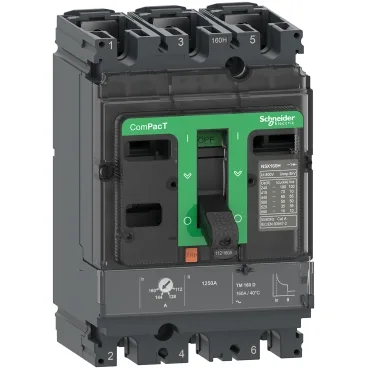
The C16H3TM125 is a Schneider Electric ComPacT NSX160H circuit breaker, 3-pole, fitted with a TM-D thermal-magnetic trip unit rated 125 A at 40 °C. It carries a 70 kA Icu breaking capacity at 415 V AC (H breaking capacity code), with the full IEC 60947-2 rating curve going up to 100 kA Icu at 240 V AC and down to 10 kA Icu at 690 V AC. That's the kind of headroom that keeps selectivity intact downstream without oversizing the upstream feeder.
The TM-D trip unit gives you L (thermal overload) and I (magnetic short-circuit) protection — no ground-fault module inside, so if you need earth-leakage, you're adding a Vigi add-on block. It's a Category A breaker (no intentional short-time delay), so it's meant for instantaneous magnetic trip on short-circuit. That makes it a clean fit for distribution panels feeding motor starters or branch circuits where you want fast clearing, not selective coordination with a downstream breaker. The 40,000 electrical cycles at 440 V In/2 and 20,000 at full In tell you the mechanical endurance is 40,000 cycles — the electrical life halves at full rated current, which is typical for a molded-case breaker.
Mounts on a backplate, horizontally or vertically, flat against the surface. The 105 mm width, 161 mm height, and 86 mm depth fit the standard ComPacT NSX footprint — same cutout as the 160 A frame across the range. Toggle control, so it's manually switchable for isolation — and it's certified for isolation per EN/IEC 60947-2, meaning you can safely use it as a visible disconnect.
The C16H3TM125 is the standard catalog number for the NSX160H frame with a 125 A TM-D trip, 3-pole. If you're freezing a BOM, this is a stable line item — the ComPacT NSX series has been a Schneider mainstay for years, and the TM-D trip is the basic thermal-magnetic option, so no surprise phase-out risk in the near term.
Power dissipation is 10.78 W per pole at rated current — 32.34 W total for the 3-pole unit. That's useful for panel thermal calculations if you're stacking multiple breakers in a sealed enclosure. The 0 to 95 % relative humidity range and 2000 m altitude without derating (5000 m with derating) cover most industrial installations outside high-altitude mining or data centers above 2000 m.