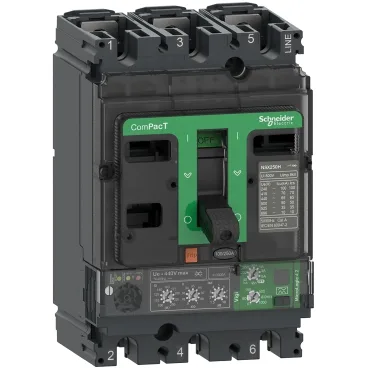
It's a 3-pole, 100 A frame with a MicroLogic 4.2 electronic trip unit that combines overload (L), short-time short-circuit (So), instantaneous short-circuit (I), and earth-leakage (R) protection in one device. The 85 kA Icu at 240 V AC (36 kA at 415 V, 35 kA at 440 V) means it can safely interrupt fault currents up to those levels without upstream fuses — a key spec for high-fault panels where you want selective coordination. The integrated earth-leakage protection (R function) eliminates a separate RCCB or ground-fault relay, saving two module widths on the DIN rail.
The 105 mm width, 161 mm height, and 86 mm depth fit standard ComPacT NSX cutouts. Front connections top and bottom — no rear-access bus required, which simplifies gland-plate layout and busbar routing in a distribution panel. IP40 enclosure protection (IK07 impact) suits it for clean indoor panels.
It's specified against EN/IEC 60947-2 and UL 60947-4-1, so it carries the approvals for both IEC and North American installations. The dual-standard listing simplifies BOM management for multinational projects.
If your panel ambient runs hotter, you'll need to derate — but the MicroLogic 4.2 is electronic, so the trip curve stays accurate across temperature, unlike a thermal-magnetic breaker that drifts with ambient heat. At 415 V it's 36 kA — still substantial for most industrial distribution. The 'F' breaking capacity code (36 kA at 415 V) tells you this is the standard-interrupting version of the NSX250 frame, not the high-interrupting 'H' or 'S' variants. Electrical durability: 20,000 cycles at 440 V at half rated current, 10,000 at full rated current. That's typical for a molded-case breaker — fine for distribution switching a few times a year, but not rated for frequent motor starting duty where you'd want a contactor.