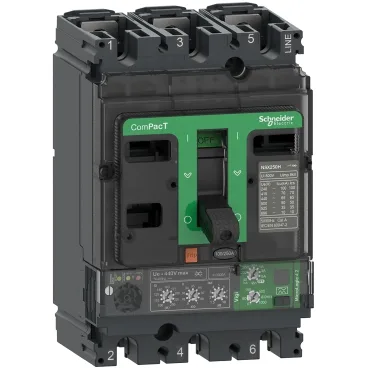
The C25F34V250 carries a full breaking capacity table across common voltages, not just one headline number. At 380/415 V AC it's rated 36 kA Icu; at 480 V AC (UL) it's 35 kA Icu; at 600 V AC it drops to 15 kA Icu. The 85 kA at 240 V AC is for North American 240/120 V split-phase service. For selectivity studies, the Ics (service breaking capacity) isn't listed here — you'd need the full datasheet to confirm whether Ics equals Icu or is a percentage. The EN/IEC 60947-2 standard this breaker is certified to requires both ratings to be published; the evidence here gives Icu only, so verify Ics for your specific coordination study.
Mounts on a backplate — no DIN rail for this frame size. The 161 mm height, 105 mm width, and 86 mm depth mean it needs a cutout or mounting plate sized for a 3-pole MCCB of this class. Connection pitch is 35 mm, which is standard for busbar or cable lugs on NSX frames. Both upside and downside connections are front-facing, so busbar runs and cable exits are on the same plane — good for a tidy panel layout. The IK07 impact rating means it can survive a 2 J hammer blow — standard for switchgear.
Earth-leakage protection — built in, not added on
The earth-leakage protection is integrated into the MicroLogic 4.2 trip unit, not a separate add-on module. That means the R (residual) protection curve is part of the same electronic package that handles overload and short-circuit. The operating mode uses the IΔn rotary switch to set the leakage trip threshold — no external relay or toroid to wire. The local signalling includes a flashing green LED for ready-to-operate, a red LED at 105% Ir for overload, and an orange LED at 90% Ir as a pre-alarm — useful for troubleshooting without opening the panel door.
Overvoltage category IV means it's suitable for the point where the utility feed enters the building, not just downstream distribution. The utilisation category is A, which means it's not intended for frequent switching of motors or transformers — it's a distribution breaker, not a motor circuit protector. The electrical durability figures give you the expected number of operations under load: 20,000 cycles at 440 V at half rated current, 10,000 at full rated current. These matter for maintenance planning on a panel that sees frequent switching.