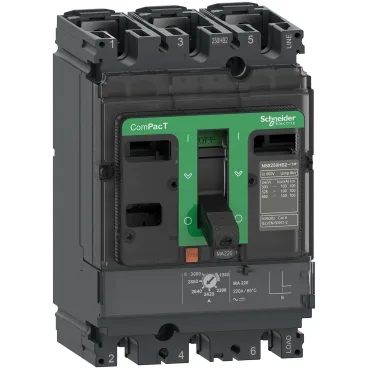
It's a 3-pole, 3-protected-pole device that provides short-circuit protection only — no thermal overload function, because that's handled by the motor starter or overload relay downstream. That makes it a straight magnetic-only breaker for the feeder or branch circuit feeding a motor, where you want magnetic trip for faults but leave the overload protection to the contactor's overload block. Rated 150 A at 65 °C, it's a 150 A frame breaker fitted with a 150 A trip unit — no derating guesswork at typical panel ambient. The breaking capacity is substantial: 85 kA Icu at 240 V AC, 36 kA at 415 V AC, and still 22 kA at 525 V AC, all per IEC 60947-2. That's enough for most industrial distribution systems with decent fault current headroom.
Where it fits — panel and system integration
IP40 enclosure protection keeps tools and fingers out; IK07 impact rating handles accidental knocks during installation. Horizontal or vertical mounting is fine — no restriction. The toggle control is manual, so it's a straightforward panel breaker, not a motorized or remote-operated unit. Five accessory slots are available for shunt trips, auxiliary contacts, or undervoltage releases.
Mechanical endurance is 20,000 cycles; electrical endurance varies by load: 20,000 cycles at 440 V at half rated current (In/2), 10,000 cycles at full rated current (In) at 440 V, and 5,000 cycles at 690 V at In/2. For a motor-protection breaker that sees occasional switching (not daily contactor duty), that's plenty. The utilization category is A — meaning it's not intended for frequent switching under load, which is standard for an MCCB in a motor branch circuit. Power dissipation per pole is 8.55 W, so three poles total about 25.7 W — factor that into panel thermal calculations.