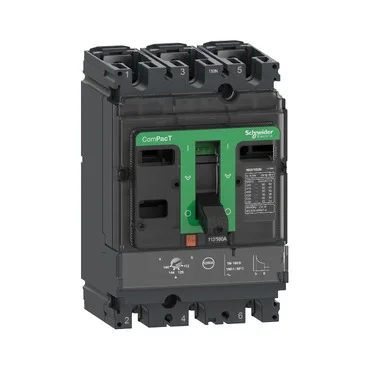
It belongs to the ComPacT NSX family, the compact, high-performance platform that replaced the earlier NS range. At 220/240 V it rises to 90 kA Icu; at 690 V it still holds 10 kA Icu. That spread covers everything from light commercial mains to heavy industrial sub-distribution. It is a fixed, non-interchangeable thermal-magnetic design — no electronic adjustment, no ground-fault module. For a 200 A feeder protecting a motor control centre or a distribution bus, that simplicity is a reliability advantage: one fewer electronic board to fail in a hot panel.
Breaking capacity — what the N code means for your panel
The part is rated for isolation — meaning it provides visible-gap disconnection when open, compliant with EN/IEC 60947-2. That saves installing a separate disconnect switch on the feeder.
Mounts on a backplate in any orientation. Width is 105 mm, height is 161 mm, depth is 86 mm. Front connections top and bottom. IP40 front face and IK07 impact resistance are adequate for enclosed distribution panels.
Durability and thermal budget
Mechanical endurance is 20,000 cycles; electrical endurance at rated current (440 V In) is 10,000 cycles, doubling to 20,000 at half load. For a main feeder that operates a few times a day, that is decades of service. Power dissipation is 15.4 W per pole — 46.2 W total at full load. That heat must be considered in the panel thermal design, especially when multiple breakers are ganged in a closed enclosure.