Integrator's note — C25R45E250
It's a distribution-grade device rated per EN/IEC 60947-2, and the 'E' in the trip unit name means it includes energy metering and power quality measurement — not just protection. The 200 kA Icu at 415 V AC is the headline number, but the real story is the 80 kA Icu at 500 V and 65 kA at 525 V; if your secondary is wound for 480 V, that's the curve you're on.
Breaking capacity — what the ratings mean
The C25R45E250 carries an R-code breaking capacity: 200 kA Icu at 220–440 V AC, 80 kA at 500 V, 65 kA at 525 V, and 45 kA at 660–690 V. Below 440 V, the Ics (service breaking capacity) is typically 100% of Icu for this series, so you don't lose coordination on reclose. At 690 V the Icu drops to 45 kA — still high, but worth noting if your line runs at that voltage.
Panel integration — mounting and connections
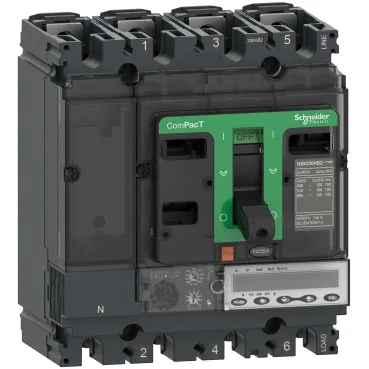
The 161 mm height, 140 mm width, and 86 mm depth fit standard distribution enclosures; the 35 mm connection pitch matches common busbar systems. The toggle control and LCD display are on the front, so settings and status are visible without opening the door.
Durability and environmental limits
Mechanical endurance is 20,000 cycles; electrical endurance at 440 V full load is 10,000 cycles (20,000 at half load). That's typical for a molded-case breaker in distribution duty — not a switching device for frequent motor starts, but fine for infrequent isolation and fault interruption. Operating altitude is 0–2000 m without derating; above that, up to 5000 m, you need to derate the insulation and interrupting capacity. IK07 impact resistance (per IEC 62262) means the enclosure withstands a 2 J impact — enough for accidental tool drops during installation.