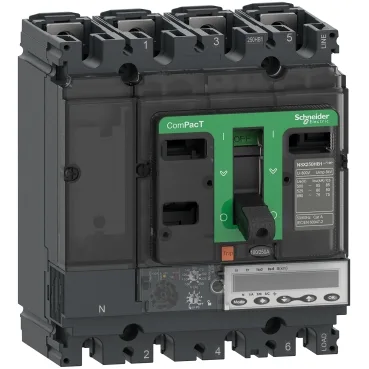
The C25V46E160 is a Schneider Electric ComPacT NSX moulded-case circuit breaker, 4-pole, with a 160 A frame and a MicroLogic 6.2 E electronic trip unit. It is designed for distribution applications and complies with EN/IEC 60947-2. The MicroLogic 6.2 E provides LSI protection — long-time overload (L), short-time short-circuit (S), and instantaneous short-circuit (I) — plus ground-fault protection (G). That means a single device covers overload, short-circuit, and ground-fault coordination, which simplifies panel design and reduces the number of components.
Breaking capacity and what it means for your system
The breaking capacity is 85 kA Icu at 500 V AC 50/60 Hz, 80 kA at 525 V, and 75 kA at 660/690 V. For a 500 V distribution board with a prospective fault current of, say, 65 kA, this breaker clears it safely. The 75 kA at 690 V is relevant for 690 V industrial networks common in mining or heavy manufacturing. Utilisation category A means it is not intended for motor starting duty — it is a distribution breaker, not a motor circuit protector.
Trip unit and metering capability
The MicroLogic 6.2 E is an electronic trip unit with an LCD display and local signalling — a flashing green LED for ready, red LED at 105 % Ir for overload, orange at 90 % Ir. It includes an energy meter and communicates energy metering, power quality, demand current, time-stamped events, and protection settings.
Mounts on a backplate in horizontal or vertical orientation, flat on the back. The 4-pole version with neutral on the left has a width of 140 mm, height 161 mm, depth 86 mm. Connection pitch is 35 mm. Front connections both upside and downside.
Durability and environmental ratings
Electrical durability varies with load: 20,000 cycles at 440 V at half rated current, 10,000 at full rated current at 440 V, 10,000 at 690 V at half current, and 5,000 at 690 V full current. That is typical for a distribution MCCB — not designed for frequent switching like a contactor, but adequate for infrequent isolation and fault interruption. IK07 impact resistance means it withstands a 2 J impact, enough for accidental tool drops in a panel. Relative humidity 0–95 %.