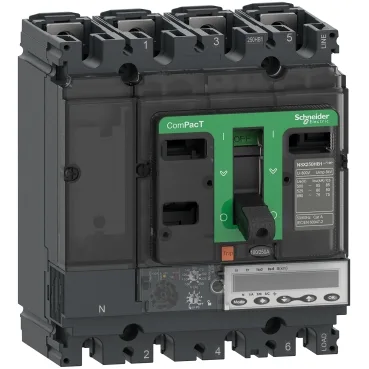
It is a 4-pole, 250 A rated breaker designed for distribution applications, using an electronic MicroLogic 6.2 E trip unit that provides L (long-time overload), S (short-time short-circuit), I (instantaneous short-circuit), and G (ground fault) protection. The breaker is rated at 85 kA Icu at 500 V AC 50/60 Hz per IEC 60947-2, and carries a 75 kA Icu at 690 V AC — the HB1 breaking capacity code tells you it handles high fault currents at higher voltages. This is not a residential-grade breaker; it belongs in an industrial panel where selectivity and coordination matter.
The MicroLogic 6.2 E trip unit is fully electronic, so you can adjust the long-time pickup, short-time delay, and instantaneous settings to coordinate with downstream breakers — not a fixed thermal-magnetic curve. The 4-pole version (4P) with neutral on the left means it switches all four poles, including the neutral, which is required for some IT or corner-grounded delta systems.
The connection pitch is 35 mm, and both upside and downside connections are front-facing, which simplifies bus-bar or cable routing in a panel. The breaker is 161 mm high, 140 mm wide, and 86 mm deep, with an IK07 impact rating per IEC 62262 — tough enough for a panel environment but not for direct mechanical abuse.
Communication and metering
The MicroLogic 6.2 E trip unit includes an energy meter and communicates time-stamped histories, event tables, protection and alarm settings, maximeters/minimeters, instantaneous and demand values, power quality data, energy metering, demand current and power, and maintenance indicators. The LCD display on the front gives local readout without needing a separate meter or gateway — useful for a commissioning engineer checking load profiles or for an MRO planner verifying trip history after a fault.