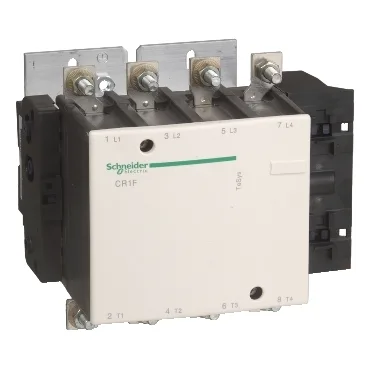
The CR1F1504MZ7 is a TeSys F magnetic latching contactor from Schneider Electric, configured with 4 normally open power poles and a 220 V DC low-consumption control circuit. It is designed for motor control and resistive load switching across utilisation categories AC-1, AC-3, and AC-4. The latching mechanism holds the main contacts closed without continuous coil power — the coil draws 500 W DC only during the 35...40 ms latching pulse, then drops to zero holding current. Unlatching requires a separate 15 W DC pulse lasting 50...100 ms. This makes it suitable for applications where sustained coil power is unavailable or undesirable, such as battery-backed or renewable-energy systems.
The rated operational current [Ie] is 150 A in AC-4 duty at 440 V AC, 40 °C ambient — this is the switching current for demanding motor loads with frequent starts and stops. For less severe AC-3 duty (starting/running motors), the conventional free air thermal current [Ith] is 250 A at 40 °C, which sets the continuous current capacity in open mounting. Motor power capability spans 40 kW at 220...230 V AC up to 100 kW at 690 V AC per IEC ratings; UL/CSA horsepower ratings are 50 hp at 240 V and 100 hp at 480 V. The rated insulation voltage [Ui] is 1000 V per IEC 60947-4-1 and BS 775, with an impulse withstand voltage [Uimp] of 8 kV — confirming suitability for 690 V line-to-line systems with adequate clearance. Rated breaking capacity is 1500 A at 440 V, dropping to 450 A at 1000 V, which defines the maximum fault current the contactor can interrupt.
Dimensions are 6.7 in (171 mm) depth, 7.9 in (201.5 mm) width, and 6.7 in (170 mm) height. Terminals accept lugs, ring terminals, a 120 mm² connector, or 25 x 3 mm bars. Tightening torque is 159.3 lbf·in (18 N·m). The contactor is panel-mounted, not DIN-rail — plan for dedicated mounting holes and bus-bar connections. Associated fuse rating is 250 A gG or aM at 440 V, or 160 A aM. Mechanical durability is rated at 1 million cycles. Power dissipation per pole is 6 W in AC-3 and 18 W in AC-1, which should be factored into enclosure thermal calculations.