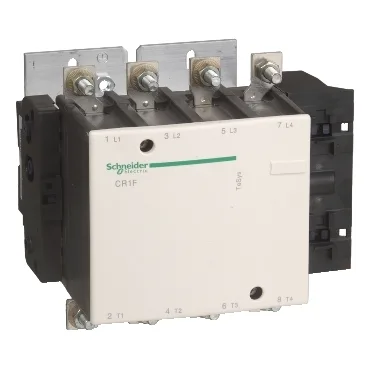
The Schneider Electric CR1F1504Q7 is a TeSys F magnetic contactor — 4-pole, latching (bistable) type, with a 380 V AC 50/60 Hz control coil. It's rated for AC-1 resistive loads: 250 A conventional free-air thermal current (Ith) at 40 °C, translating to 150 A rated operational current (Ie) in AC-1 duty. The 4 NO power pole configuration handles switching without a neutral pole, common for three-phase resistive banks or distribution switching. This is a latching contactor — the coil draws 1100 VA inrush to latch, then holds at 7.3 VA unlatching (50/60 Hz). The unlatch time runs 50–100 ms, latch time 35–40 ms. That pulse-and-hold profile means the coil is not continuously energized in the latched state; the magnetic circuit holds mechanically. Useful in applications where sustained coil power is undesirable or where a power-loss memory is needed.
For motor loads (AC-3), this contactor is not the right choice — the AC-1 rating is the only utilization category listed. The 250 A Ith figure is the thermal current in free air, which governs busbar and cable sizing at the terminals. The 18 W power dissipation per pole at AC-1 means a 4-pole contactor dumps 72 W into the enclosure — factor that into panel ventilation if it's in a sealed cabinet. Breaking capacity is substantial: 1500 A at 220–440 V, 1200 A at 500 V, 1100 A at 600–690 V, and 450 A at 1000 V for the power circuit. Making capacity is 1700 A rms. That's enough for fault clearing on most 400 V distribution panels, but the associated fuse ratings (160 A aM, 250 A gG/BS88) should be observed for short-circuit coordination.
Dimensions: 301 mm height, 201.5 mm width, 171 mm depth. This is a panel-mount contactor, not DIN-rail — it bolts to a backplate. The TH protective treatment (tropicalization) means it's coated for humidity and mild corrosive environments. Operating altitude is 3000 m without derating; ambient temperature range is –15 to 70 °C. Mounting position tolerance is ±5° from vertical. Mechanical durability is rated at 1,000,000 cycles. Maximum operating rate is 120 cycles per minute at 40 °C. The control circuit insulation voltage is rated at 1000 V per IEC 60947-4 and BS 775, with 1500 V per VDE 0110 group C. That covers most industrial control panel insulation requirements.