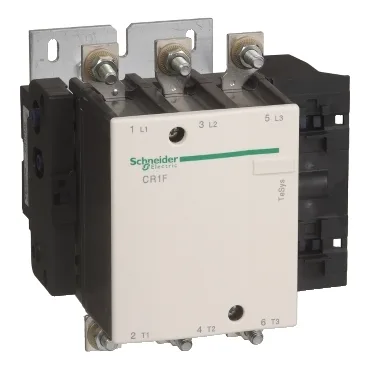
The CR1F185EZ7 is a TeSys F magnetic latching contactor from Schneider Electric — 3-pole, 3 normally-open main contacts, rated 185 A in AC-3 duty for motor switching and 275 A in AC-1 for resistive loads. The coil is 48 V DC, low-consumption type, drawing 500 W to latch and 20 W to unlatch. Latching contactors hold their state without continuous coil power, which is useful in battery-backed or energy-conscious circuits where a sustained coil draw would be a problem. The 185 A AC-3 rating means it handles motor starting currents up to that level — typical for a 75–90 kW induction motor on 400 V three-phase. AC-1 at 275 A covers resistive heater or lighting banks. The utilisation categories are per IEC 60947-4-1, so the ratings are directly comparable with other IEC contactors in the same frame size.
Rated operational voltage is 1000 V AC at 25–200 Hz, with an insulation voltage of 1000 V per IEC 60947-4-1 and 1500 V per VDE 0110 group C. That puts it in the standard 690 V industrial distribution class with headroom for 1000 V applications. The rated breaking capacity is 1800 A at 440 V — enough to clear a bolted fault on a 185 A motor branch circuit without welding the contacts. The coil voltage limits are 0.85 to 1.1 Uc for both latching and unlatching — so the 48 V DC coil holds in from about 40.8 V to 52.8 V. Below that, the contactor drops out. Operating time is 35–40 ms to latch, 50–100 ms to unlatch. That is slower than a standard contactor but expected for a magnetic-latching mechanism that mechanically holds its state. That is adequate for most motor-starting duty but not for high-speed jogging or continuous cycling applications. Power dissipation per pole is 12 W in AC-3 and 26 W in AC-1 — factor that into enclosure heat rise if the contactor runs near its thermal limit.
The contactor measures 7.1 in deep by 6.6 in wide by 6.9 in high. Terminals accept bars (2 × 25 × 3 mm), ring lugs up to 150 mm², or a connector for 150 mm² cable. Tightening torque is 159.3 lbf·in (18 N·m) — a substantial torque that needs a torque wrench, not a screwdriver. The protective treatment is TC (standard tropicalised coating) for moderate humidity environments. Associated fuse ratings are 200 A aM (motor-protection) or 315 A gG (general-purpose) at up to 440 V. The short-time withstand current is 1500 A for up to 10 seconds at 40 °C — that defines the upstream protection coordination window.