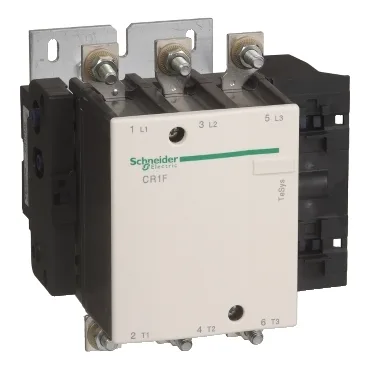
The Schneider Electric CR1F265E7 is a TeSys F magnetic latching contactor — a 3-pole, normally open device rated for 265 A in AC-4 duty at 440 V. The magnetic latching mechanism means the coil only draws power during the switching transition (1800 VA latching, 12 VA unlatching), then holds the contacts magnetically with zero holding current. This makes it a fit for applications where continuous coil power is undesirable or where a power loss must not drop out the load. The 48 V AC/DC control coil operates within 0.85 to 1.1 Uc for both latching and unlatching, giving a clean pickup and dropout window. Rated operational voltage goes to 1000 V AC, with insulation rated at 1000 V per IEC 60947-4 and 1500 V per VDE 0110 group C.
The headline 265 A AC-4 rating is the motor-switching current for reversing or plugging duty — the toughest thermal cycle for a contactor. For less severe AC-3 (start-run) or AC-1 (resistive) duty, the contactor handles higher currents; the 350 A figure at 40 °C covers those curves. The 132 kW motor power at 400 V AC-4 gives a direct sizing anchor for a 400 V line. Short-time withstand (Icw) is 2200 A for 1 second at 40 °C, dropping to 480 A for 10 minutes — this tells you the contactor can ride through a fault long enough for an upstream breaker or fuse to clear, without welding its own contacts. The associated fuse recommendation is 315 A aM or 400 A gG at 440 V, so coordination with a motor protection curve is straightforward. Rated breaking capacity reaches 2450 A at 440 V, meaning it can interrupt a fault current of that magnitude without damage. Making capacity is 2940 A rms, confirming it can close onto a faulted circuit.
This is a panel-mount contactor, not a DIN-rail snap-on. The power circuit uses bolted connections accepting lugs, ring terminals up to 240 mm², or bars (2 x 32 x 4 mm). Tightening torque is 35 N·m — a standard torque wrench setting for this class of bolted power connection. The 213 mm depth, 201.5 mm width, and 203 mm height mean it needs a backpanel footprint roughly 8 x 8 inches with clearance for cable bending radius.
The operating rate is 120 cycles per hour at 40 °C — adequate for most motor starting and switching duty.