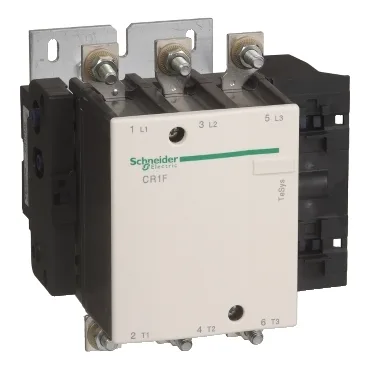
The Schneider Electric CR1F265R7 is a TeSys F magnetic latching contactor — a 3-pole device rated for 265 A operational current (AC-3, ≤440 V) and 350 A thermal current (Ith) at 50 Hz, with a 0.32 mOhm average impedance per pole. It holds its closed state without continuous coil power, drawing 1800 VA during the latching pulse and only 12 VA to unlatch, which cuts heat and energy in applications where the contactor stays closed for long periods. Rated insulation voltage is 1000 V (IEC 60947-4), and it handles motor loads from 75 kW at 230 V up to 160 kW at 690 V (AC 50/60 Hz). For UL/CSA circuits, it switches 150 hp at 480 V and 175 hp at 575 V. The contactor covers utilisation categories AC-1 (resistive), AC-3 (squirrel-cage motor start/run), and AC-4 (plugging/inching), so it fits both general switching and demanding motor control.
The 265 A AC-3 rating is the figure that governs motor switching — it tells you this contactor can handle a 132 kW motor at 400 V or a 160 kW motor at 690 V under normal starting duty. The AC-1 rating (resistive load) is higher, but for motor control, AC-3 is the binding limit. The latching mechanism is the differentiator here: once pulsed, it holds magnetically with no coil current, so it suits applications where a sustained closed state is needed without continuous power draw — like remote switching stations or energy-sensitive lines. The unlatching pulse is the same 12 VA, so the control circuit only sees a brief load. Operating time is 40–75 ms to latch and 50–100 ms to unlatch.
It mounts to a panel or a notched AM1-EC rail — the standard TeSys F footprint. Dimensions are 8.4 in deep, 7.9 in wide, 8.0 in tall (213 x 201.5 x 203 mm). Terminals accept lugs, ring terminals, or bars up to 240 mm² per pole, with a tightening torque of 35 N·m. Ambient operating range is -15 to 70 °C, with no derating up to 3000 m altitude. For power circuit protection, the associated fuse rating is 315 A aM or 400 A gG (≤440 V).
Compliant with IEC 60947-4, BS 5424, NF C 63-110, VDE 0660, and JEM 1038 — the key standards for contactors and motor-starters. The TH protective treatment indicates tropicalisation for humid environments.